
Your needs, this model
Does it fit your priorities?
Can I have a plastic drinking surface, continuous outlet-powered flow and at least 1.8 liters of nominal capacity?
Yes. This exact plastic 64 oz configuration provides continuous outlet-powered bubbling and a nominal US-fluid capacity of about 1.89 liters.
Explore this need in the finder →Does this exact plastic configuration supply a stainless-steel drinking surface?
No. PWW00-17919 has the plastic tray. The separately identified ZWW00-17921 is the steel-tray configuration.
Explore this need in the finder →Does the nominal capacity meet a two-liter minimum?
No. The advertised sixty-four US fluid ounces converts to approximately 1.89 liters, below two liters.
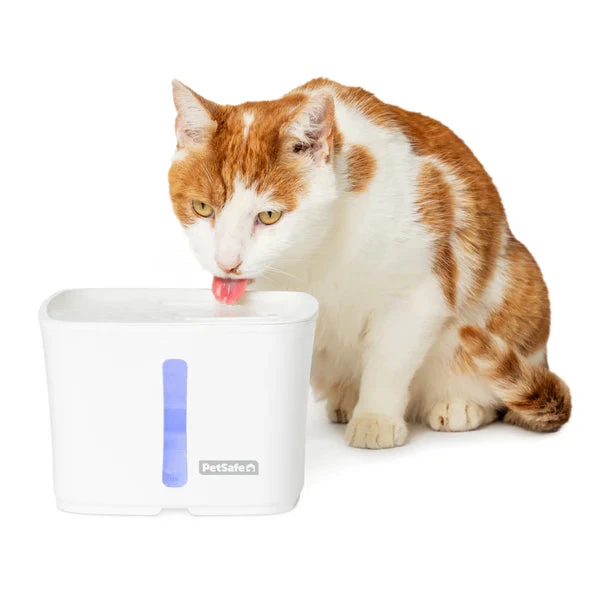
Explore this need in the finder →The plastic 64 oz Viva is a straightforward outlet-powered bubbler for someone who wants moving water without app setup or a battery-charging routine. Its practical attractions are the visible water window, automatic low-water shutdown and dishwasher permission for the removable bowl, housing and drinking tray. Its ownership cost is mostly attention: checking the water, cleaning a wired submersible pump and replacing two different filters on different schedules.
Choose the actual 64 oz plastic configuration
PWW00-17919 is the US 64 oz plastic version. Its nominal capacity is approximately 1.89 liters when converted from US fluid ounces. That is a reservoir specification, not a promise that a particular cat can be left for a set number of days. Refilling depends on drinking, evaporation, spills and the number of pets using the fountain, so the front window remains useful even when the pump appears to be running normally.
The 64 oz stainless-tray Viva keeps the same named capacity while changing the drinking surface. The 140 oz plastic version holds more than twice the advertised water. Choose this smaller plastic package because its capacity and surface suit your routine, rather than assuming that every Viva listing supplies the larger reservoir or the steel tray.
Continuous bubbling with adjustment at the pump
The documented setup uses the pump cord and an external power adaptor connected to a wall outlet. Water bubbles through the center of the tray while the powered system runs. USB describes the power connection; it does not establish rechargeable main-unit operation. Someone who needs to place a fountain away from an outlet should evaluate a documented battery configuration separately.
The pump has a physical flow-control knob. PetSafe recommends the highest setting during initial setup, and its assembly guidance explains that the higher setting produces more bubbling than the lower setting. Adjusting that knob is part of assembling or accessing the pump, rather than selecting a mode on an external screen. That can suit someone who wants a simple local adjustment and does not need scheduled or pet-approach flow.
The pump sits in a housing inside the bowl. Its power cord passes through the bowl's tube and is secured by a silicone cap. Follow that routing carefully: the cap holds the cord in place and helps prevent water following the opening out of the bowl. This is also a reason to disconnect power before moving or taking the fountain apart.
Understand the blue and red light
The quick-start guide describes a blue pump LED visible through the window during operation. When the water becomes low, the pump shuts off and the LED glows red. The guide says the pump restarts after refilling. These are useful local status signals, but they do not report how much an individual cat has drunk.
Do not substitute the light for a direct look at the water and the fountain's condition. A low-water cutoff identifies a limit; it does not top up the reservoir. If your priority is app records or individual attribution, this simple local setup is not documented to provide those functions. The practical reason to choose it is uncomplicated bubbling and a visible refill check.
Plan for the pump as well as the dishwasher parts
PetSafe permits the bowl, pump housing and tray on the dishwasher's top rack. The pump must be opened and cleaned by hand, and the adaptor stays out of the dishwasher. Remove the faceplate, stator and magnetic impeller as instructed so that cleaning reaches the parts moving the water. Washing only the white outer pieces leaves that separate pump job undone.
The maker's starting schedule is to clean the fountain and pump every two to four weeks, with more frequent attention when needed in a multiple-pet household. Replace the carbon-and-ion-exchange filter every two to four weeks and the foam filter every one to two months. Do not wash the filters with soap. Keeping those two schedules distinct is more useful than treating both filter pieces as one monthly cartridge.
Who is the plastic Viva for?
Choose this exact configuration when a plastic drinking tray, continuous outlet-powered bubbling and a roughly two-liter nominal reservoir are appropriate. The larger Viva changes capacity; the steel-tray Viva changes the contact surface. For a documented battery option, compare the HydroSphere Cordless, noting that its battery setup uses sensor flow rather than preserving the Viva's continuous outlet-powered routine.
Sources: exact PetSafe US configuration; original shared Viva quick-start guide; manufacturer cleaning guidance.
Key details at a glance
| Reservoir and capacity limits | 64 US fluid oz nominal capacity, approximately 1.89 L. Numeric matching uses the stated US fluid-volume conversion. Follow the MAX fill line; capacity does not promise days between checks. |
|---|---|
| Power arrangement | Outlet-powered pump and external adaptor are the documented setup. The pump cord passes through the bowl tube and silicone cap. USB power is not a verified rechargeable main-unit or backup-battery arrangement. |
| Water flow and conditions | Continuous center bubbling while outlet powered. A physical flow-control knob on the pump changes the amount of bubbling; the setup guide starts with the highest setting. |
| Drinking surface and wet parts | Plastic drinking tray in the exact selected configuration; separate bowl, pump housing and filters still require cleaning. |
| Cleaning and source limitations | Bowl, pump housing and tray have top-rack dishwasher permission. Pump is opened and hand cleaned; adaptor stays out. Clean every two to four weeks and as needed; replace carbon/ion-exchange filter every two to four weeks and foam every one to two months. Keep soap out of filters. |
| App and observation limits | Blue and red pump LED signals operating and low-water status. App intake records, individual attribution, direct Wi-Fi and a drinking-area nightlight are not documented. |
Use the exact model’s instructions for operating limits, supplied equipment and version differences.
Sources for this assessment
- Exact current US PWW00-17919 selector and per-variant JSON-LD image
- Current official Viva support / operation / care article
- Original Viva quick-start guide RE400-2557,8pages,©2024; all three exact US models
- Current official Viva support / operation / care article
- Current official Viva support / operation / care article
- Current official Viva support / operation / care article
- Current official Viva support / operation / care article
- Current official Viva support / operation / care article
- Current official Viva support / operation / care article
- Current official Viva support / operation / care article
Find the configuration your household needs.
Start with power and water flow, then add surface, cleaning and observation requirements.