
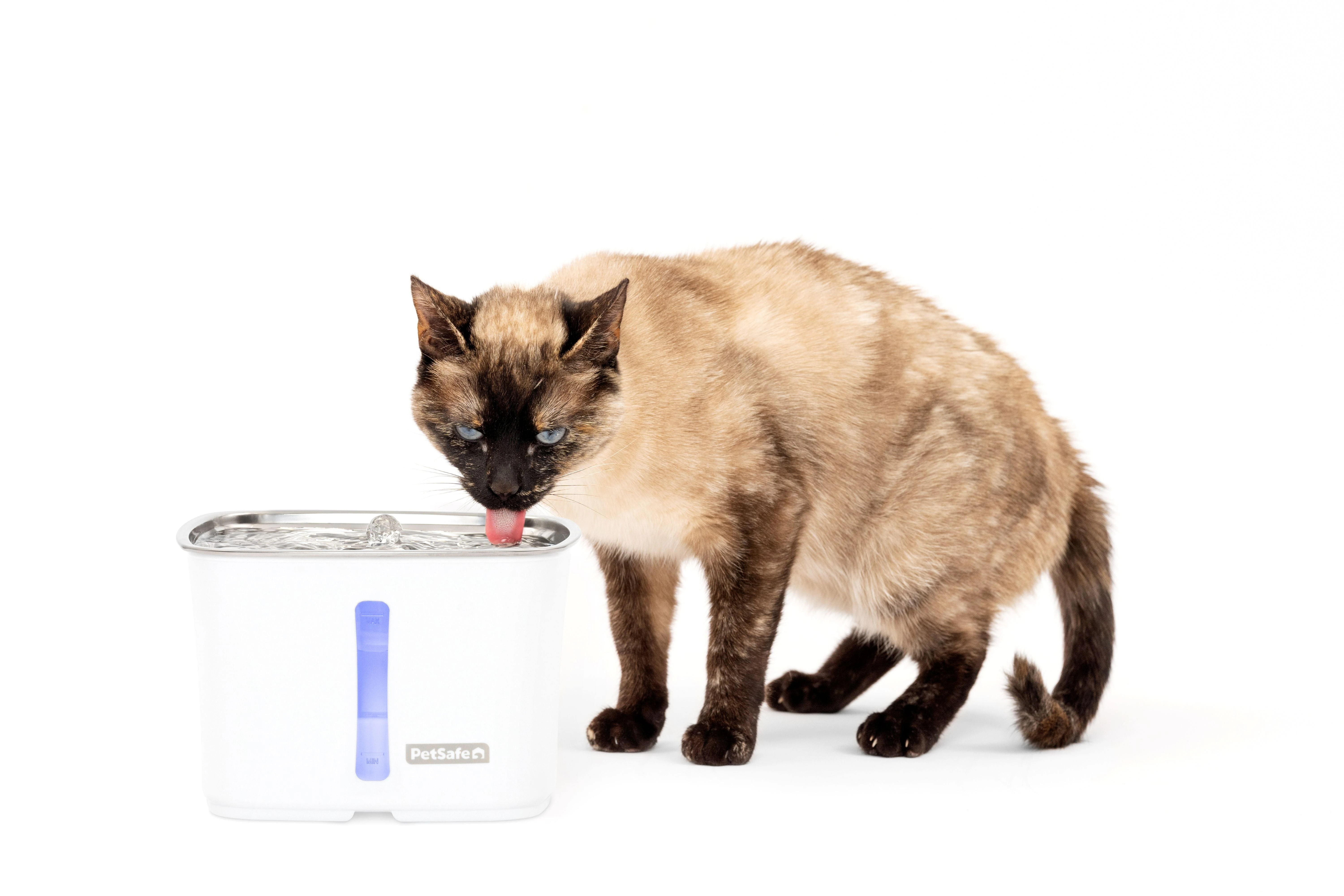
Your needs, this model
Does it fit your priorities?
Can I have a stainless drinking surface with dishwasher permission and continuous outlet-powered flow?
Yes. The supplied steel tray has top-rack dishwasher permission in the shared exact-model guide. The pump remains a separate hand-cleaning task.
Explore this need in the finder →Can this steel-tray model provide continuous flow using a rechargeable main-unit battery?
No documented battery setup is supplied for this requirement. The guide shows the pump cord and an external adaptor plugged into an outlet.
Explore this need in the finder →Does the motor stay in a dry base while an electrically empty reservoir lifts off?
No. The wired submersible pump sits in the bowl, with its power cord routed through the bowl tube.
Explore this need in the finder →The steel-tray Viva is for someone who likes the Viva's simple bubbling routine but specifically wants a stainless-steel drinking surface. The important distinction is where the steel is: ZWW00-17921 changes the upper tray, while retaining a multi-part bowl, filter and submerged pump arrangement. It should be chosen for that particular contact surface, rather than as a completely steel fountain or a way to avoid pump cleaning.
The stainless option is a 64 oz configuration
The current US selector identifies this as 64 oz / Stainless Steel. Its nominal capacity converts to approximately 1.89 liters in US fluid units. It is not the 140 oz reservoir with a metal top. In the current three-configuration US family, the larger 140 oz Viva has a plastic drinking tray, while the other 64 oz model also uses plastic.
That gives you a real choice between more nominal stored water and a different drinking surface. If you need the larger volume, do not assume that a generic Viva product photograph or material selector guarantees a 140 oz steel version. Check the exact SKU and selected combination on the item offered.
The reservoir capacity also does not determine a refill calendar. Several pets, spills and your cleaning routine can change how often you need to replenish it. The front water window is there for a direct check; the pump's continued operation is not a measurement of how much water a particular cat has consumed.
A local bubbler, powered from an outlet
The documented operating arrangement connects the pump cable to a wall-powered adaptor. Water bubbles through the center of the drinking tray continuously while the fountain is powered and sufficiently filled. A USB power cable does not by itself establish a battery mode or emergency backup.
Flow is adjusted with a physical knob on the pump. The setup guide starts with the highest flow setting; PetSafe's assembly article explains that higher flow makes more bubbling than the lower setting. This is an internal mechanical adjustment, so it suits someone comfortable setting up the pump before closing the fountain. It is a different routine from changing modes in an app or relying on an approach sensor.
The low-water system is useful but limited in purpose. A blue LED is visible through the window when operating. At low water, the pump stops and the light turns red; the guide says refilling allows it to restart. That local indication can help you notice a refill need, but it does not provide drinking records or identify different cats.
Dishwasher permission does not include the pump
The shared guide expressly permits the bowl, pump housing and tray on the dishwasher's top rack. That is useful for the supplied steel drinking surface. The pump and adaptor are excluded: the pump must be dismantled and hand cleaned, and the adaptor stays dry. A steel top does not move the motor into a separate dry base.
Remove the pump faceplate, stator and magnetic impeller using the maker's sequence so that you can reach the internal passages. Use the cleaning method PetSafe specifies, rinse appropriately and reassemble the small pieces carefully. It is worth considering that task before choosing a fountain based primarily on its metal top.
PetSafe's normal planning interval is two to four weeks for cleaning the fountain and pump, with more frequent work as needed for multiple pets. The carbon filter, which also contains ion-exchange resin, has a two-to-four-week replacement interval. The foam filter's interval is one to two months. Keep soap out of both filter pieces rather than washing them as if they were part of the tray.
Choose it for the surface and routine you want
This Viva is a sensible fit when you want a steel drinking tray, the smaller named capacity and simple continuous flow near an outlet. It is less suitable when you need battery placement, app intake attribution or a larger reservoir with the same steel surface. Those are separate requirements that its tray material does not satisfy.
The HydroSphere Stainless is another steel-tray comparison, with a stated 1.7 L capacity and a supplied splash guard. The larger plastic Viva changes capacity within this family. Match the complete cleaning, power and refill routine first, then choose the contact surface that you prefer.
Sources: exact US steel-tray selector; Viva original model-specific quick-start guide; pump cleaning instructions.
Key details at a glance
| Reservoir and capacity limits | 64 US fluid oz nominal capacity, approximately 1.89 L. Numeric matching uses the stated US fluid-volume conversion. Follow the MAX fill line; capacity does not promise days between checks. |
|---|---|
| Power arrangement | Outlet-powered pump and external adaptor are the documented setup. The pump cord passes through the bowl tube and silicone cap. USB power is not a verified rechargeable main-unit or backup-battery arrangement. |
| Water flow and conditions | Continuous center bubbling while outlet powered. A physical flow-control knob on the pump changes the amount of bubbling; the setup guide starts with the highest setting. |
| Drinking surface and wet parts | Stainless steel drinking tray over a separate bowl, pump housing and filters. The drinking-surface label does not describe every wet component. |
| Cleaning and source limitations | Bowl, pump housing and tray have top-rack dishwasher permission. Pump is opened and hand cleaned; adaptor stays out. Clean every two to four weeks and as needed; replace carbon/ion-exchange filter every two to four weeks and foam every one to two months. Keep soap out of filters. |
| App and observation limits | Blue and red pump LED signals operating and low-water status. App intake records, individual attribution, direct Wi-Fi and a drinking-area nightlight are not documented. |
Use the exact model’s instructions for operating limits, supplied equipment and version differences.
Sources for this assessment
- Exact current US ZWW00-17921 selector and per-variant JSON-LD image
- Current official Viva support / operation / care article
- Original Viva quick-start guide RE400-2557,8pages,©2024; all three exact US models
- Current official Viva support / operation / care article
- Current official Viva support / operation / care article
- Current official Viva support / operation / care article
- Current official Viva support / operation / care article
- Current official Viva support / operation / care article
- Current official Viva support / operation / care article
- Current official Viva support / operation / care article
Find the configuration your household needs.
Start with power and water flow, then add surface, cleaning and observation requirements.