
Your needs, this model
Does it fit your priorities?
Can I require at least 3.5 liters of nominal capacity and an electronics-free lift-off water assembly?
Yes. The 128 US fluid-ounce label converts to about 3.78 liters, and the guide leaves the motor and electronics in the dry base.
Explore this need in the finder →Can I require the main fountain to run from a rechargeable battery?
That setup is not documented. The included USB cable and wall adaptor power the base from an outlet.
Explore this need in the finder →Can it attribute drinking records to two cats with paired tags?
That is not established. Its local status light reports water level, a filter timer and motor issues; it is not a tagged individual-intake setup.
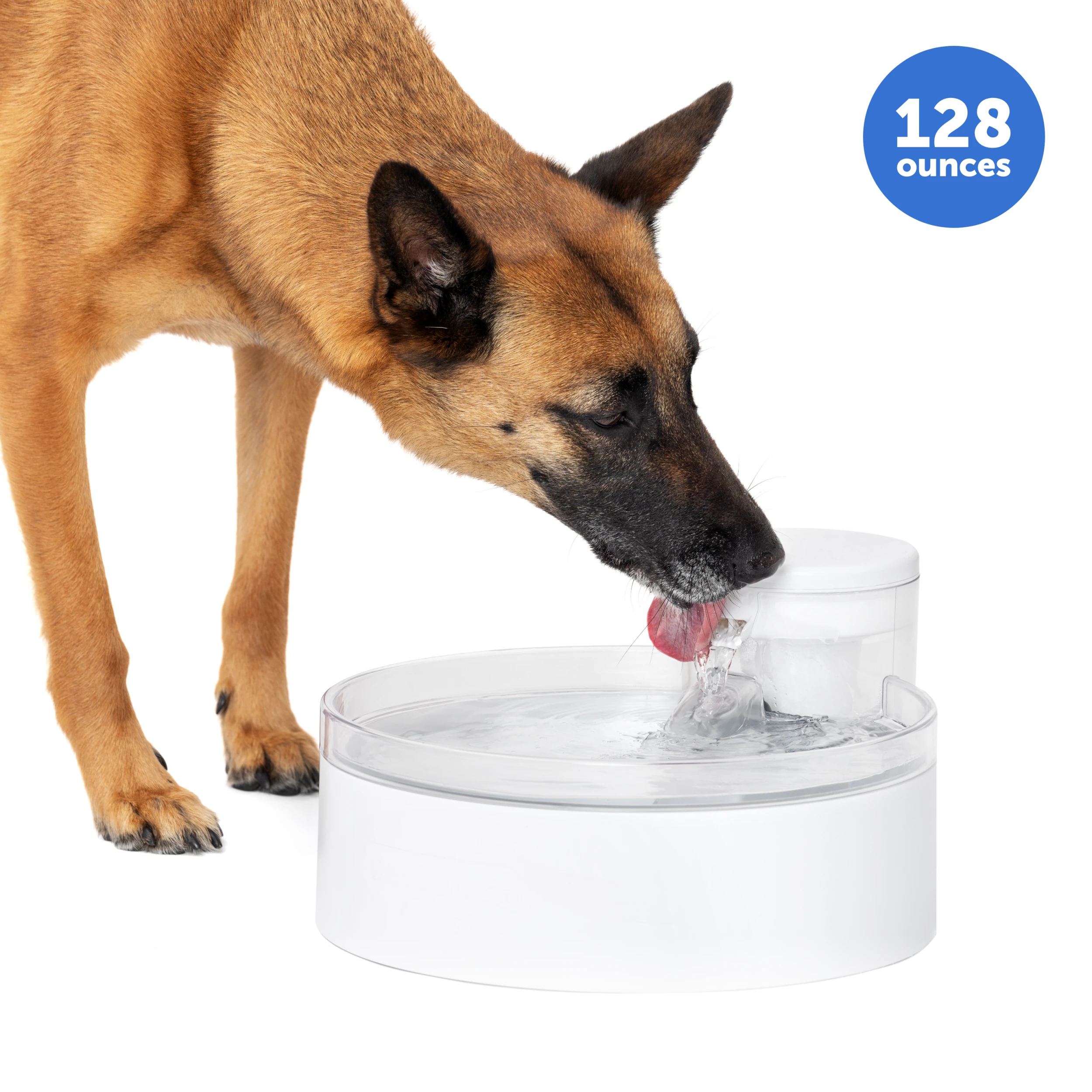
Explore this need in the finder →The PetSafe Outlast 128 oz is the open-bowl member of the Outlast family, identified in the US as PWW00-17959. Although its support page calls it a dog fountain, PetSafe also describes this model for cats and mixed-pet households. Its reason to consider is the larger shared bowl and nominal water capacity, combined with a motor that stays in a dry base instead of being submerged in the reservoir.
The drinking layout changes as well as the capacity
The nominal 128 US fluid ounces converts to approximately 3.78 liters. It provides more reservoir capacity than the 90 oz Outlast, but it cannot establish how many days a household may leave it unchecked. More animals sharing a bowl can also mean more debris and a faster-changing water level. Check the water and cleanliness regularly.
The 60 and 90 oz versions have a clear tray fitted over the bowl; the 128 oz instructions omit that tray and use the open bowl. This is a meaningful choice for a household comparing a shallow tray arrangement with a more open shared drinking area. Do not assume the largest model is simply the smaller fountain with a taller hidden tank.
Consider carrying and refilling the whole water assembly
The bowl lifts off the electrical base. That makes it possible to move the water assembly to the sink without carrying the motor and electronics along, but a filled larger bowl still deserves a stable route and a comfortable grip. Before choosing a permanent position, consider the trip to the sink and whether furniture or other bowls will obstruct lifting it clear.
Fill only to the marked maximum. The shared guide permits leaving the fountain unplugged while a hesitant pet gets used to drinking from it. That offers a gradual introduction to the bowl before adding moving water. It is not a reason to rely on residual water without checking whether the bowl is actually filled and accessible.
Continuous circulation uses an outlet
The supplied USB cable and wall adaptor power the base. Place it within the guide's six-foot range of an outlet. The cone rotates to lift water to the tower and spout, with flow expected to begin within 30 seconds after connection and correct assembly. There is no documented rechargeable operating mode for this exact configuration.
The motor slows slightly in a dark room and resumes its daytime speed with light. This is a nighttime adjustment, not a pet-approach trigger or an interval schedule. If the intended location has no suitable outlet, compare the battery arrangement of the PETLIBRO Dockstream 2 rather than treating Outlast's pump-free description as cordless operation.
The motor stays dry, while the cone and bowl still need cleaning
Unplug or lift the bowl from the base before changing the filter or cleaning. The base is not waterproof and must not be rinsed or submerged. The removable non-base fountain parts have dishwasher permission, with the product specifying the top rack; remove the filter first. The absence of a submerged motor simplifies one part of cleaning but leaves wet mechanical parts that still require inspection.
PetSafe recommends cleaning every two to four weeks or as needed. With a shared open bowl, inspect visible debris whenever checking the level and clean sooner when necessary. Fully seat the bowl and cone when rebuilding, fit the spout and secure the tower lid before running it. Blinking red status can require checking those assembly points as well as the water level.
The reminders describe the device rather than each animal
The Ion-X filter combines carbon and ion-exchange media. A blinking blue light is a 21-day replacement reminder, which needs resetting after the filter change. It does not analyze the water or tell you whether one pet used the fountain. The reset button is on the base under the tower, so the bowl must be lifted to access it.
Low water produces a steady red warning, and running dry stops the motor. Refilling to the maximum line allows it to restart. Those local safeguards are useful, but a mixed-pet household seeking individually attributed drinking records needs a different system. Compare the tagged PETLIBRO Dockstream RFID with attention to which animals can use the required identification setup.
Choose the Outlast 128 when a larger open bowl, lift-off wet assembly and outlet-powered circulation fit the household. Choose the 60 or 90 oz models for their tray arrangement, or compare an explicitly steel drinking surface such as the Catit PIXI Steel if that material is essential. Capacity should support a routine you can maintain, not replace regular attention.
Key details at a glance
| Reservoir and capacity limits | 128 US fluid ounces nominal capacity, approximately 3.78 liters after unit conversion rounded down to two decimals. This is not a measured usable-water volume or a promise of days between checks. |
|---|---|
| Power arrangement | The supplied USB cable and wall adaptor power the separate dry base. The setup guide places the fountain within 6 feet of an outlet; no rechargeable operating plan is documented. |
| Water flow and conditions | Continuous normal circulation from a rotating cone, with slightly slower motor speed when the room is dark. This is not pet-approach sensing or a timed dispensing schedule. |
| Drinking surface and wet parts | The 128 oz model uses the open bowl and omits the separate drinking tray assigned to the 60 and 90 oz models. A specific drinking-surface material grade is not established by the read US documentation. |
| Cleaning and source limitations | Remove the filter and lift the bowl off the base before washing. Non-base fountain parts have top-rack dishwasher permission. The electrical base is not waterproof and must not be rinsed or submerged. Clean every two to four weeks or as needed; the filter reminder is a 21-day timer. |
| App and observation limits | Local red/blue indications concern water level, a filter timer and motor condition. App intake records or individual-cat identification are not established. The normal blue status light is not assumed to be a drinking-area nightlight. |
Use the exact model’s instructions for operating limits, supplied equipment and version differences.
Sources for this assessment
Find the configuration your household needs.
Start with power and water flow, then add surface, cleaning and observation requirements.