
Your needs, this model
Does it fit your priorities?
Can I have at least 1.8 liters of nominal capacity, continuous outlet-powered flow and accessible bowl water when pumping stops?
Yes. The half-gallon model supplies about 1.89 liters nominally, with a wired continuous-flow setup and explicitly retained open-bowl water.
Explore this need in the finder →Does this half-gallon configuration meet a two-liter nominal minimum?
No. Sixty-four US fluid ounces is approximately 1.89 liters, below two liters.
Explore this need in the finder →Can this fountain provide continuous flow from a rechargeable main-unit battery?
No documented battery operating plan meets that requirement. The original guide uses a pump cord, inline plug and wall adaptor.
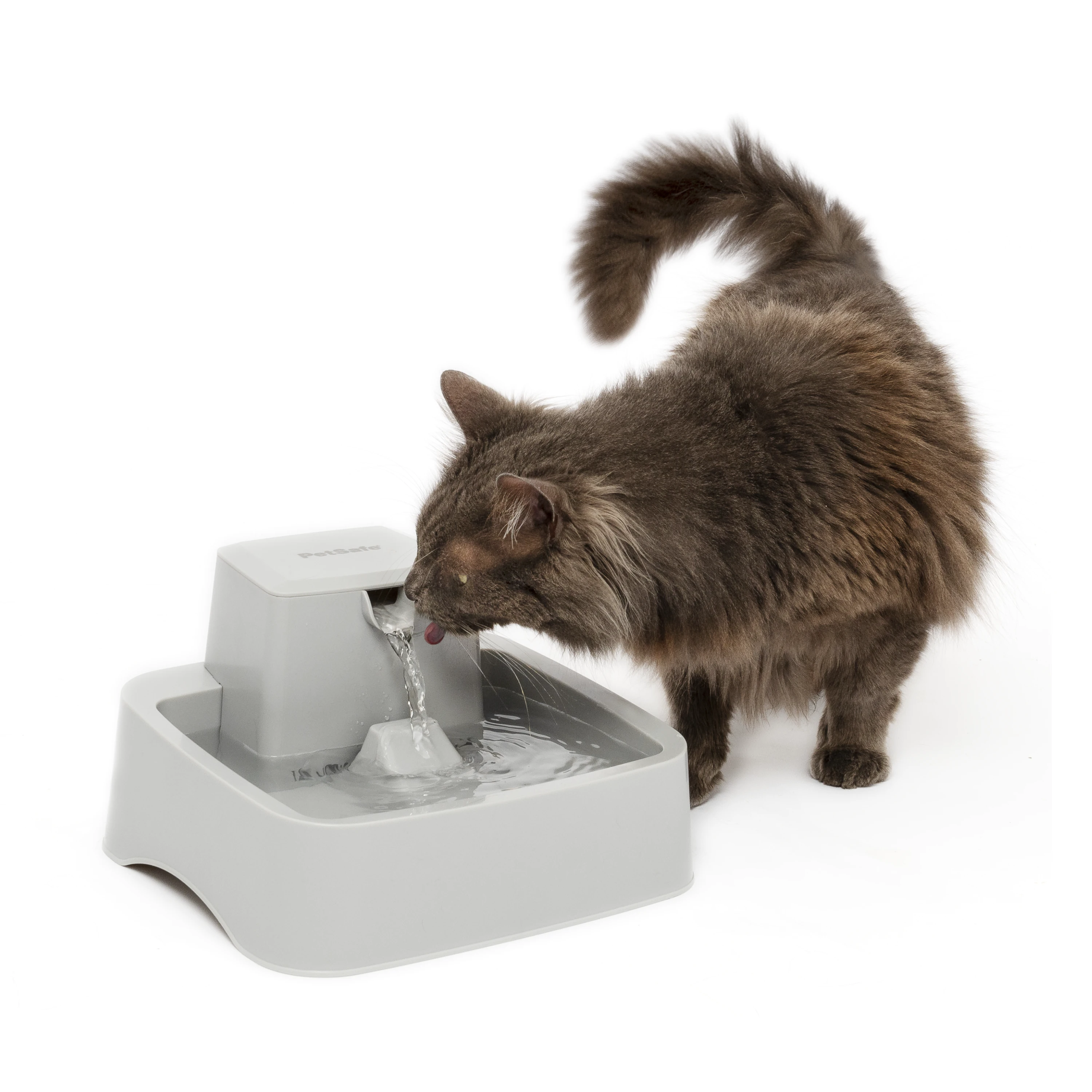
Explore this need in the finder →The PetSafe Oasys 64 oz PWW00-16790 is the smallest of three plastic, open-bowl fountains in this family. Its attraction is straightforward: an adjustable falling stream, water that remains accessible in the bowl when power stops, and a modest nominal capacity for someone who would rather handle a smaller drinking station. The current Oasys name replaces Drinkwell on the product page, so older Drinkwell instructions are relevant when their model list includes this exact number.
A smaller bowl still needs room for servicing
Sixty-four US fluid ounces is half a US gallon, approximately 1.89 liters. That makes this model smaller than the 128 oz Oasys and 256 oz Oasys, but capacity alone cannot tell you how often a particular cat's bowl will need topping up. Drinking, evaporation, spilled water and your cleaning routine all affect that decision. Check the actual water regularly rather than planning around an assumed number of days.
PetSafe's table gives this size as 9.5 by 6.2 inches without clearly labelling the two axes. Measure your intended spot and confirm the dimensions that matter before placing it under a tight shelf. Leave space to remove the lid and tower, and plan a route to a sink. The guide says to carry the fountain by its bowl; the tower is part of the water assembly, not a carrying handle.
Choose the falling stream, then keep the pump supplied
A knob at the top of the tower adjusts the stream from stronger flow through reduced flow to shutoff. It must be installed: a missing knob or its lowest setting can leave the spout without a stream. This is useful when introducing a cat to moving water because you can change the presentation locally, without a phone or pairing process. A quiet-looking spout is not, by itself, proof that a pump needs replacement.
The supplied arrangement is a submersible pump connected through an inline plug to a wall adaptor. The manual describes continuous operation while plugged in, provided the fountain is clean and the water level is maintained. It specifies a fill level half an inch below the rim and warns against letting water fall below one inch from the base. Those instructions make daily observation important. Automatic low-water shutdown is not established for this model, so it should not replace your water check.
The open bowl is a separate advantage. PetSafe expressly says water remains available if the power goes out. That means accessible stored water, not continuing circulation, a rechargeable backup, or a promise that the entire advertised capacity remains drinkable at every operating level. If the outlet is inconvenient, choose a fountain with an actual battery operating plan rather than trying to turn this wired pump into a cordless product.
Plastic parts can go on the top rack; the pump cannot
The drinking bowl and fountain body are plastic. The guide permits the non-electrical parts on the dishwasher's top rack, while the pump and adaptor stay out. This distinction matters if dishwasher convenience is your main reason for choosing it: the job still includes opening the pump, removing its faceplate, stator and magnetic impeller, and cleaning those components by hand.
The water path also includes a connector tube that separates into two halves. Take advantage of that access rather than only wiping the visible bowl. Reassembly includes seating the pump's suction cups, routing the cable through the bowl opening, pressing its rubber seal firmly into place and taking up excess slack. A rushed seal or loose tube can create a problem that a fresh filter will not fix.
Two consumables have different schedules. The carbon filter is replaced every two to four weeks; the foam filter every one to two months. Rinse the carbon filter with water before installation and keep soap out of both filters. The manual identifies an 80 percent water and 20 percent white-vinegar mixture for hard-water deposits. Follow the cleaning instructions for the actual part rather than soaking the adaptor or treating a filter as a washable sponge.
Who should choose this size?
Choose the 64 oz Oasys if you want a compact member of an open-bowl stream family, have an accessible outlet, accept plastic drinking surfaces and will keep up with pump cleaning. It makes particular sense when a smaller bowl is easier to carry and wash than a gallon-size station. A larger reservoir is worth considering when stored-water capacity is the real constraint, but the larger Oasys models keep the same general service tasks.
If a steel drinking tray or documented low-water shutdown matters more than the falling stream and retained bowl, compare the 64 oz stainless-tray Viva. Steel there describes the tray, not every wet component. If you want intake records, identification of individual cats or battery-powered placement, this Oasys is a poor match for those requirements. Its useful simplicity is physical control over a stream and an accessible bowl, supported by regular hands-on care.
Key details at a glance
| Reservoir and capacity limits | 64 US fluid oz nominal capacity, approximately 1.89 liters. Fill half an inch below the rim and maintain at least one inch of water above the bowl base; inspect regularly. |
|---|---|
| Power arrangement | The documented setup uses a wired submersible pump, inline plug and wall adaptor for continuous outlet-powered operation. Accessible water in an outage does not establish a rechargeable backup. |
| Water flow and conditions | A physical knob on the tower increases, reduces or shuts off the falling stream. The knob must be installed; its lowest setting or removal leaves no spout flow. |
| Drinking surface and wet parts | Plastic open drinking bowl and tower. The electrical pump, filters and connector tube remain separate components of the water path. |
| Cleaning and source limitations | Non-electrical plastic fountain parts have top-rack dishwasher permission. Open and hand-clean the pump; keep pump and adaptor out of the dishwasher and soap out of filters. Replace carbon every two to four weeks and foam every one to two months. |
| App and observation limits | The open bowl retains accessible water when electricity stops. No app intake records, individual attribution or Wi-Fi capability is established by the bowl or physical flow control. |
Use the exact model’s instructions for operating limits, supplied equipment and version differences.
Sources for this assessment
- Current exact US Oasys PWW00-16790 capacity selector and variant image assignment
- Official exact Drinkwell gallon-family support and care article
- Original Drinkwell half-, one- and two-gallon Quick Start Guide RE400-2332/3, 12 pages, copyright 2020
- Official exact Drinkwell gallon-family support and care article
- Official exact Drinkwell gallon-family support and care article
- Official exact Drinkwell gallon-family support and care article
Find the configuration your household needs.
Start with power and water flow, then add surface, cleaning and observation requirements.