
Your needs, this model
Does it fit your priorities?
Can I have at least three liters, a plastic drinking surface with top-rack permission and retained bowl water?
Yes. This one-gallon configuration holds about 3.79 liters nominally. Its plastic drinking bowl has top-rack permission and remains accessible when power stops; the pump and adaptor stay out of the dishwasher.
Explore this need in the finder →Does the one-gallon model meet a four-liter nominal minimum?
No. Its 128 US fluid ounces converts to approximately 3.79 liters.
Explore this need in the finder →Does its water reservoir lift off while the electrical motor remains in a separate dry base?
No. The wired submersible pump sits inside the bowl, and its cable passes through a rubber-sealed bowl opening.
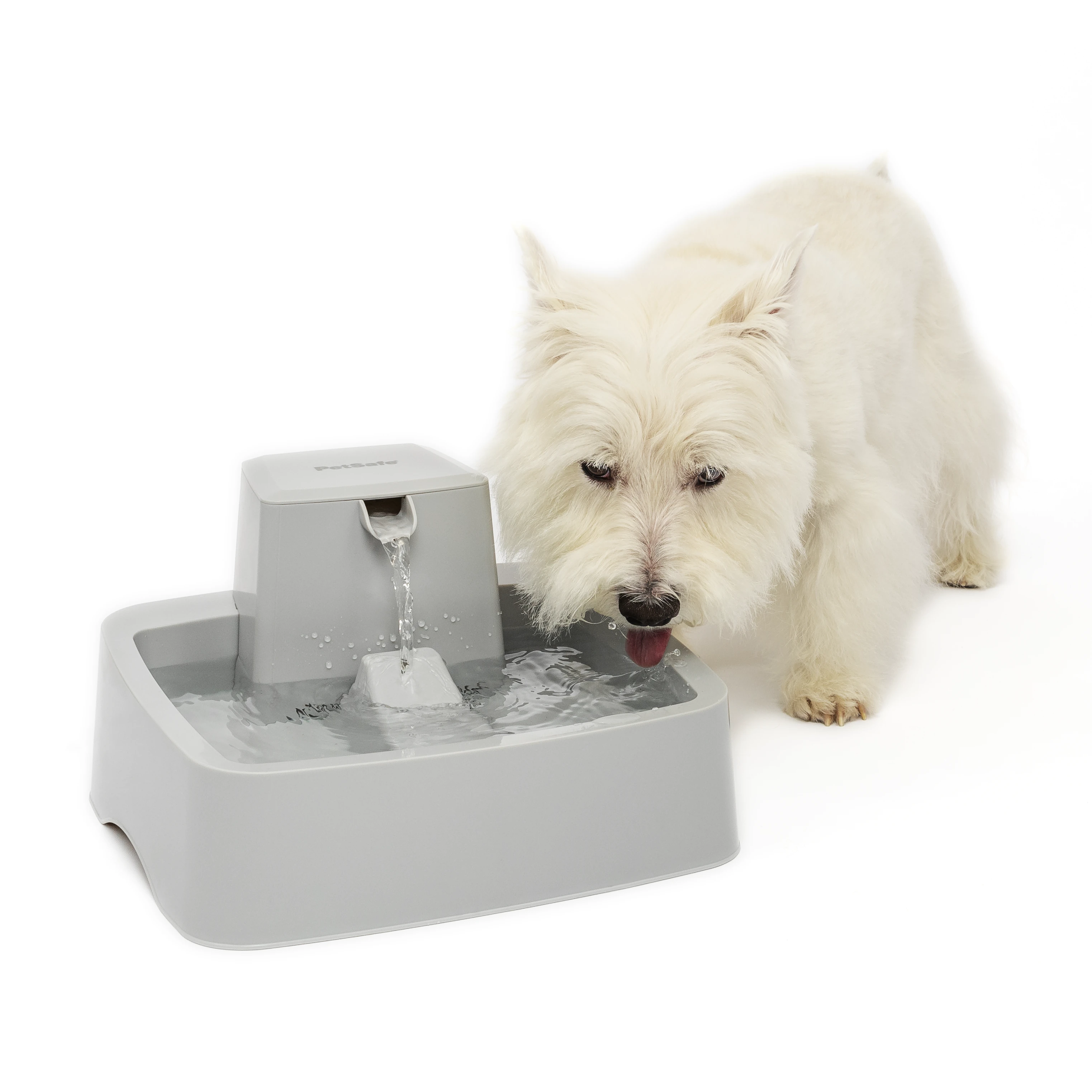
Explore this need in the finder →The PetSafe Oasys 128 oz PWW00-16777 occupies the middle of the Oasys range: a one-US-gallon plastic bowl with an adjustable falling stream and a wired submersible pump. It is worth considering when the smaller half-gallon model feels restrictive but a two-gallon bowl would be awkward to lift and wash. The extra stored water is its defining difference; it does not add battery operation, drinking records or a different cleaning system.
A gallon is a capacity choice, not a refill schedule
The advertised 128 US fluid ounces converts to approximately 3.79 liters. That clears a three-liter minimum but falls short of four liters, an important distinction if you are comparing gallon-labelled products with metric reservoirs. The rating is nominal capacity, not a measured amount available between the recommended fill level and the pump's minimum water level.
PetSafe instructs owners to fill half an inch below the bowl rim and never let the level fall below one inch from the base. Check the water regularly even if the bowl appears generous for one cat. A second pet, evaporation or splashing can change the routine, and the fountain's capacity cannot establish a reliable number of unattended days. A cat's individual water needs are also not something the gallon label measures.
The product table lists 11.5 by 7.5 inches for this configuration without clearly identifying the axes. Treat that as a prompt to confirm placement dimensions, rather than a complete labelled width-depth-height envelope. Beyond fitting the bowl on the floor, allow room to unplug it, lift off the tower and carry the bowl to a sink. The current cleaning instructions suggest removing some water with a cup first if the filled fountain is heavy.
The bowl and stream offer different ways to drink
A cat can approach the falling stream or drink from the open water below. The tower's physical knob changes the stream strength and can shut it off. The knob has to be installed correctly; the original guide specifically warns that no stream comes from the spout when the knob is missing or at its lowest setting. Check that simple cause before dismantling the pump to investigate reduced flow.
The open bowl also provides a useful power-outage distinction. PetSafe says stored water remains accessible when electricity stops. This does not keep the pump circulating, and it does not turn the product into a battery fountain. The documented operating arrangement is the pump's cord, an inline connection and the supplied wall adaptor. The manual describes continuous plugged-in use while water and cleanliness are maintained.
There is no confirmed automatic low-water shutdown in the read instructions. If that feature is essential, do not equate a visible water bowl with an automatic safeguard. The 140 oz Viva documents low-water shutdown and a larger nominal fluid rating, although its bubbling presentation differs from Oasys's falling stream. Both need regular inspection and pump care.
Budget time for the hidden water path
The Oasys's dishwasher permission applies to its non-electrical fountain parts on the top rack. The pump and adaptor are excluded. You still open the pump to remove and wash the faceplate, stator and magnetic impeller. Clean the connector tube as well: it splits into two pieces so the enclosed passage is accessible. An attractive bowl surface does not show whether those hidden parts are clean.
Correct reassembly is part of the maintenance burden. The pump sits on suction cups in the bowl, foam surrounds it, and the cable passes through an opening sealed by a rubber grommet. The guide calls for pressing that seal firmly into place and removing extra cable slack. Keep the cord above the foam filter as directed and position the tower on its matching notches. These are repeatable physical tasks rather than an app-guided cleaning cycle.
Replace the carbon filter every two to four weeks and the foam filter every one to two months. Those are separate replacement intervals, not permission to leave old water or residue until a timer expires. Rinse filters with water only; soap can remain trapped in the media. For hard-water buildup, the manual gives an 80 percent water and 20 percent white-vinegar mixture. Unplug and disconnect the inline plug before dismantling anything.
The sensible middle size, with clear limits
The one-gallon Oasys is a good candidate if you prefer a visible open pool, want a tunable falling stream and can manage a larger plastic bowl at the sink. Choose the 64 oz version when carrying and washing a smaller station matters more than stored capacity. Move to the 256 oz version only if its additional volume and larger bowl genuinely suit the space and handling routine.
Choose another design if a steel drinking surface, a reservoir that lifts off while electronics remain in a dry base, or off-outlet operation is essential. The Oasys keeps its wired pump inside the bowl. It suits a household that values an uncomplicated stream and accessible water, and is willing to inspect and dismantle the fountain as part of normal care.
Key details at a glance
| Reservoir and capacity limits | 128 US fluid oz nominal capacity, approximately 3.79 liters. Fill half an inch below the rim and maintain at least one inch of water above the bowl base; inspect regularly. |
|---|---|
| Power arrangement | The documented setup uses a wired submersible pump, inline plug and wall adaptor for continuous outlet-powered operation. Accessible water in an outage does not establish a rechargeable backup. |
| Water flow and conditions | A physical knob on the tower increases, reduces or shuts off the falling stream. The knob must be installed; its lowest setting or removal leaves no spout flow. |
| Drinking surface and wet parts | Plastic open drinking bowl and tower. The electrical pump, filters and connector tube remain separate components of the water path. |
| Cleaning and source limitations | Non-electrical plastic fountain parts have top-rack dishwasher permission. Open and hand-clean the pump; keep pump and adaptor out of the dishwasher and soap out of filters. Replace carbon every two to four weeks and foam every one to two months. |
| App and observation limits | The open bowl retains accessible water when electricity stops. No app intake records, individual attribution or Wi-Fi capability is established by the bowl or physical flow control. |
Use the exact model’s instructions for operating limits, supplied equipment and version differences.
Sources for this assessment
- Current exact US Oasys PWW00-16777 capacity selector and variant image assignment
- Official exact Drinkwell gallon-family support and care article
- Original Drinkwell half-, one- and two-gallon Quick Start Guide RE400-2332/3, 12 pages, copyright 2020
- Official exact Drinkwell gallon-family support and care article
- Official exact Drinkwell gallon-family support and care article
- Official exact Drinkwell gallon-family support and care article
Find the configuration your household needs.
Start with power and water flow, then add surface, cleaning and observation requirements.