
Your needs, this model
Does it fit your priorities?
Can I have seven liters of nominal capacity, continuous outlet-powered flow and retained drinking water if power stops?
Yes. The two-US-gallon configuration provides approximately 7.57 liters nominally. Its actual wired operating plan supplies continuous flow, while the open bowl retains accessible stored water when pumping stops.
Explore this need in the finder →Does this two-gallon model provide at least eight liters of nominal capacity?
No. Two US gallons is approximately 7.57 liters, below eight liters.
Explore this need in the finder →Is automatic low-water shutdown confirmed for the large Oasys?
Not confirmed. The guide instead requires regular water checks and warns against allowing water below one inch from the bowl base.
Explore this need in the finder →The PetSafe Oasys 256 oz ZWW00-16558 is the two-US-gallon member of this plastic open-bowl range. It offers approximately 7.57 liters of nominal stored water, an adjustable falling stream and access to bowl water if power stops. Its appeal is substantial capacity with direct physical controls. Its main compromise is equally tangible: a large water-filled bowl still has to be checked, emptied, dismantled and cleaned.
Decide how you will empty it before buying
This size is more useful when you have a genuine capacity requirement than when you simply want the largest option. Seven liters is within its nominal rating; eight liters is not. Neither figure establishes the usable amount between the instructed fill and minimum levels. The guide says to leave half an inch below the rim and keep water at least one inch above the bowl base to avoid pump damage.
Water is heavy, and a two-gallon fountain can make an ordinary trip to the sink inconvenient. PetSafe's current cleaning article offers a practical approach: remove some water with a cup before moving a nearly full bowl. Carry the fountain by the bowl rather than pulling on its tower or cable. Think about the distance to a sink or tub, the strength needed to support the bowl and whether its parts fit comfortably in your washing area.
The current table gives this configuration as 14.6 by 10.1 inches, without a clearly labelled pair of axes. Confirm the complete dimensions for a confined location and allow extra working space to lift off the tower. A roomy reservoir cannot compensate for a location where you cannot reach the power connection or remove parts easily. Keep the wall outlet above the fountain level as the guide directs.
Large capacity does not change the power arrangement
A submersible pump sits in the bowl and connects to an external wall adaptor through an inline plug. The manual describes continuous plugged-in operation with adequate water and regular cleaning. This is not a rechargeable main-unit arrangement, and increasing the reservoir does not provide a cordless mode. It also does not confirm automatic low-water shutdown. Regular water checks remain necessary even if the large bowl takes longer to run down in your particular household.
The tower knob lets you increase, reduce or shut off the falling stream. Install it even if you expect to leave the flow setting alone: PetSafe warns that an absent knob, like the lowest setting, leaves the spout without flow. This gives you a useful local adjustment when a cat is hesitant about a moving stream, but it does not measure that cat's drinking or attribute water use between animals.
PetSafe explicitly says the open bowl leaves water accessible during a power outage. That can be a sensible reason to choose this layout over one whose drinking surface depends entirely on pumping. The benefit is retained bowl water, not continued filtration or a promise about how many hours the water stays suitable. Check and refresh the water as part of ordinary care.
A bigger bowl shares the same detailed cleaning work
The bowl and tower are plastic, with a carbon filter, foam filter, connector tube and electrical pump forming the water path. The manual permits the non-electrical fountain parts on the dishwasher's top rack. The pump and adaptor must stay out, and the filters should not be washed with soap. If you want dishwasher convenience, first check whether the large bowl actually fits your rack without forcing it.
Cleaning the pump means removing the faceplate, stator and magnetic impeller and washing those parts by hand. The connector tube splits into two halves for access to its inside surfaces. During reassembly, the pump's suction cups secure it to the bowl; its cable runs through a rubber-sealed opening and out through the bottom notch. Press the seal firmly into place and remove excess slack. Those hidden passages and seals deserve attention alongside the visible drinking pool.
The carbon filter has a two-to-four-week replacement interval, while the foam filter is replaced every one to two months. More capacity does not extend those stated intervals. PetSafe specifies an 80 percent water and 20 percent white-vinegar mixture for mineral deposits. Unplug the adaptor and disconnect the inline plug before emptying or dismantling the fountain, and keep the electrical connections dry when reconnecting it.
Choose capacity without buying the wrong routine
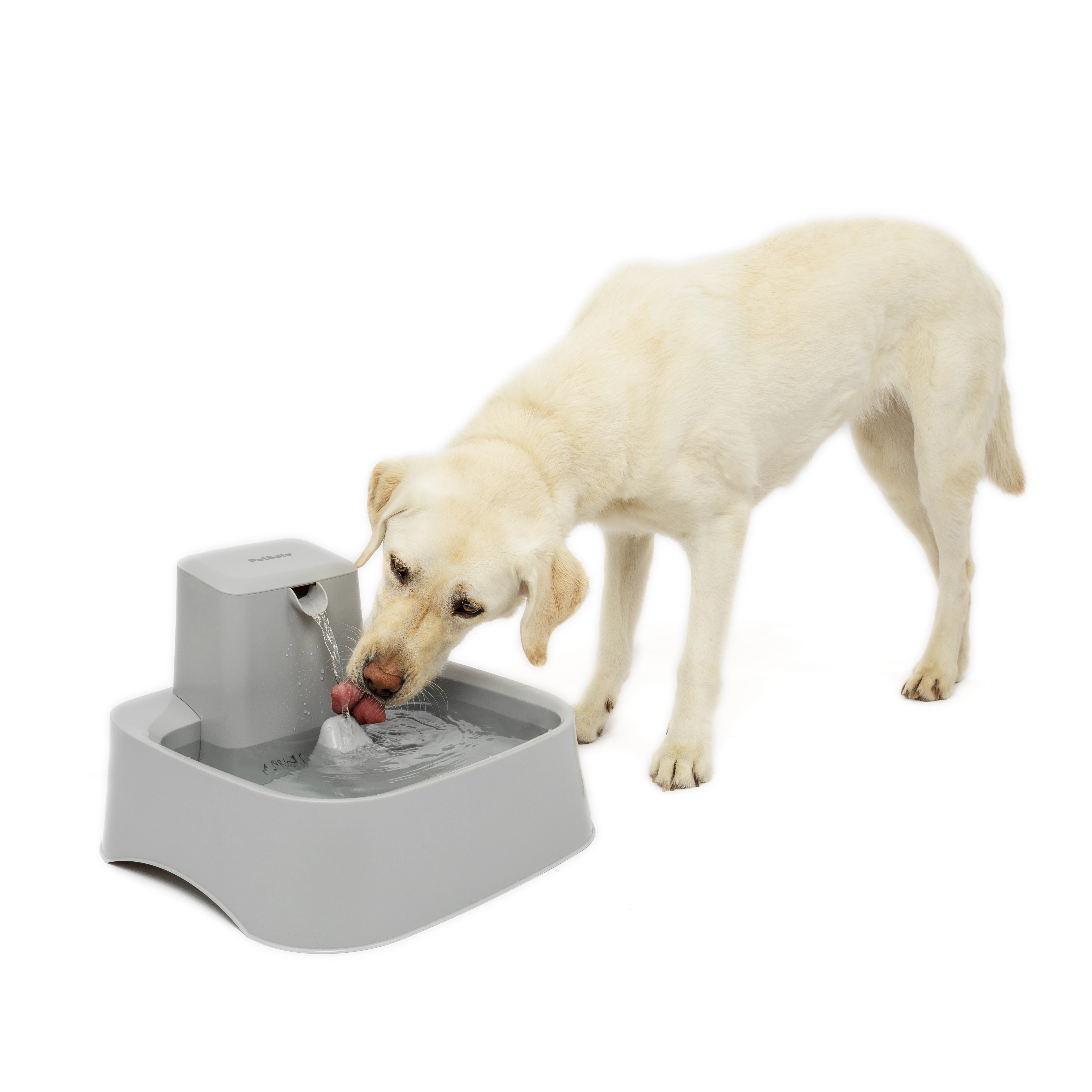
Choose the two-gallon Oasys if a large open reservoir and adjustable stream suit your pets, you have an accessible outlet, and you can manage the bowl and maintenance. A dog in the manufacturer's demonstration photograph does not identify a different dog-only model; this exact current product is also listed for cats. Check the bowl's accessibility for your own animal rather than assuming capacity determines suitability.
The one-gallon Oasys is the more manageable alternative when roughly 3.79 liters is sufficient. The half-gallon version reduces the size further. If a steel drinking surface, documented automatic shutdown or individual drinking records matters more than maximum stored volume, compare those capabilities directly rather than choosing this model for capacity alone. This Oasys is best understood as a large, serviceable stream-and-bowl station that still needs an attentive owner.
Key details at a glance
| Reservoir and capacity limits | 256 US fluid oz nominal capacity, approximately 7.57 liters. Fill half an inch below the rim and maintain at least one inch of water above the bowl base; inspect regularly. |
|---|---|
| Power arrangement | The documented setup uses a wired submersible pump, inline plug and wall adaptor for continuous outlet-powered operation. Accessible water in an outage does not establish a rechargeable backup. |
| Water flow and conditions | A physical knob on the tower increases, reduces or shuts off the falling stream. The knob must be installed; its lowest setting or removal leaves no spout flow. |
| Drinking surface and wet parts | Plastic open drinking bowl and tower. The electrical pump, filters and connector tube remain separate components of the water path. |
| Cleaning and source limitations | Non-electrical plastic fountain parts have top-rack dishwasher permission. Open and hand-clean the pump; keep pump and adaptor out of the dishwasher and soap out of filters. Replace carbon every two to four weeks and foam every one to two months. |
| App and observation limits | The open bowl retains accessible water when electricity stops. No app intake records, individual attribution or Wi-Fi capability is established by the bowl or physical flow control. |
Use the exact model’s instructions for operating limits, supplied equipment and version differences.
Sources for this assessment
- Current exact US Oasys ZWW00-16558 capacity selector and variant image assignment
- Official exact Drinkwell gallon-family support and care article
- Original Drinkwell half-, one- and two-gallon Quick Start Guide RE400-2332/3, 12 pages, copyright 2020
- Official exact Drinkwell gallon-family support and care article
- Official exact Drinkwell gallon-family support and care article
- Official exact Drinkwell gallon-family support and care article
Find the configuration your household needs.
Start with power and water flow, then add surface, cleaning and observation requirements.