
Your needs, this model
Does it fit your priorities?
Can I require a plastic drinking surface, retained water and automatic low-water shutdown?
Yes. The standard PIXI documents the supplied plastic top, shallow retained pool and automatic low-water stop. Continue checking the water and flow.
Explore this need in the finder →Can I require rechargeable pumping away from an outlet?
No battery operating route is established. Its retained pool is a bowl feature, while the pump uses the supplied adapter.
Explore this need in the finder →Can I require a confirmed reservoir of at least 2.5 liters?
Not from the conflicting current specifications. The same model page also says 2 liters, so capacity remains unknown until clarified.
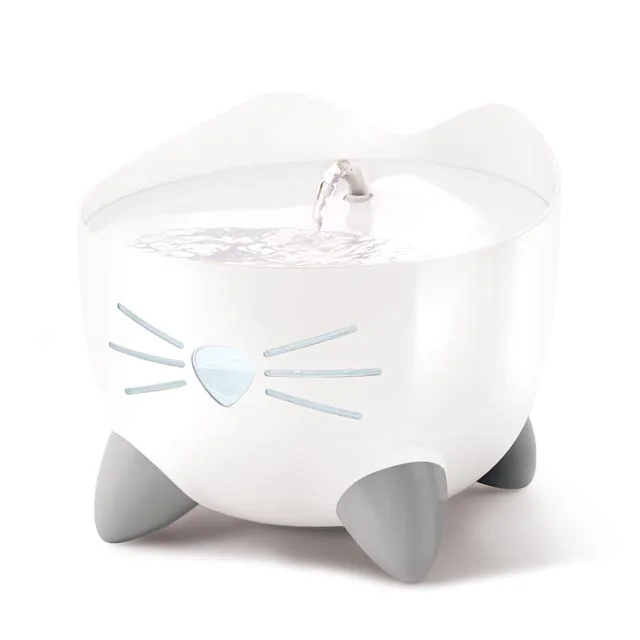
Explore this need in the finder →The standard Catit PIXI Fountain is a sensible option when you want visible water-level warnings and a choice of stream shapes without building the routine around an app. Its shallow front bowl retains some water when the pump stops. The main compromises are a pump that still needs hands-on cleaning and an unresolved capacity inconsistency on the current product page.
One design, four documented colors
Catit groups white 43715, pink 43716, blue 43717 and green 43718 on the same official product page and in the 43715–43720 guide. We assess those standard plastic-top colors together. The separately sold 43720 steel-top configuration receives its own assessment because its drinking surface and dishwasher permission materially change the purchase.
The standard page currently presents both 2.5-liter and 2-liter reservoir figures for these same color IDs. We have not chosen the larger figure to make it pass a capacity requirement. If a verified minimum capacity is essential, obtain clarification for the exact package before ordering. A familiar model name does not resolve conflicting published specifications.
Change the stream before changing the machine
The supplied spout creates an arching stream. Without it, water bubbles up and flows toward the front bowl. That gives you a practical way to offer different presentations without buying a second fountain immediately. Observe which arrangement your cat actually uses and place the appliance where the approach is easy and stable.
The bowl's retained water is useful during a brief pause in pumping, but it is not battery operation. The main pump uses the supplied USB power connection and adapter. If the intended location has no suitable outlet, compare a genuine rechargeable model such as the Dockstream PLWF115, including the flow restrictions that apply when it is unplugged.
The nose is a status indicator
The illuminated nose and whisker window signal low water and an empty reservoir. The exact guide documents automatic shutdown when water becomes too low, with operation resuming after refilling. That is a useful prompt for the person doing daily checks. It is not a substitute for looking at the water, making sure it is flowing and confirming the fountain is clean.
This standard PIXI assessment does not establish app control, individual consumption records or a sensor-triggered battery mode. Those are separate requirements. The PIXI Smart 43751 offers remote controls and status notifications, while the Dockstream RFID uses compatible collar tags for a different identification task.
Suspending the pump does not eliminate pump care
Catit's design suspends the pump rather than resting it against the reservoir. That explains the maker's noise-reduction approach, but we have not measured sound in a home. Placement, water level and accumulated debris can still affect the experience. Do not buy on the assumption that a quiet-design claim means there will never be audible water or motor noise.
The guide recommends cleaning the fountain and rinsing the filter every three days, with weekly pump cleaning. It also describes replacing the filter sooner if it is dirty or blocked. Open and clean the impeller area as instructed. Refilling a tank leaves those deposits in place, so easy access for cleaning matters as much as the ability to pour in more water.
Choose the top and the ownership routine together
The plastic-top color family does not inherit the steel top's specific dishwasher permission. If dishwasher cleaning of the drinking surface is essential, compare the factory steel-top package or an explicitly compatible separately purchased top. An accessory route requires buying that part; the reviewed standard configuration should not be credited as if it already contains it.
This is a document-based assessment of the exact official page and guide, without hands-on testing or promises about a cat's health. Check the current package and capacity clarification before buying. Find a plastic drinking surface with retained water and low-water shutdown if those are the differences that matter in your home.
Key details at a glance
| Reservoir and capacity limits | Capacity is unresolved: the current same-model page prints both 2 L and 2.5 L. Do not use the larger value for a minimum-capacity promise. |
|---|---|
| Power arrangement | The main pump uses the supplied USB adapter connection. Retained water in the bowl is not battery-powered pumping. |
| Water flow and conditions | Continuous circulation with an optional arching spout or bubbling presentation. The shallow front bowl retains water when pumping stops. |
| Drinking surface and wet parts | Supplied plastic drinking top. White 43715, pink 43716, blue 43717 and green 43718 are the official color family; the 43720 steel-top package is assessed separately. |
| Cleaning and source limitations | The guide recommends fountain cleaning and filter rinsing every three days, with weekly pump care. Unplug before handling parts and clean the impeller area. |
| App and observation limits | Local low-water and empty-reservoir indications with automatic shutdown. Intake records and app controls are not established for this standard configuration. |
Use the exact model’s instructions for operating limits, supplied equipment and version differences.
Sources for this assessment
Find the configuration your household needs.
Start with power and water flow, then add surface, cleaning and observation requirements.