
Your needs, this model
Does it fit your priorities?
Can I require camera-based profiles for up to fifteen pets and direct dual-band Wi-Fi?
Yes. The current US P4117 page supports up to 15 camera profiles and both Wi-Fi bands after app setup. Confirm current service terms for the camera features needed.
Explore this need in the finder →Can this model run continuously on its own rechargeable battery?
No. The documented P4117 uses its supplied outlet adapter; no main operating battery is established.
Explore this need in the finder →Can I require a steel drinking tray, at least five liters of clean-water supply and dishwasher permission for the drinking surface?
Yes. The clean tank is 5 L and the steel tray is one of the three specifically named dishwasher-safe removable parts. The electrical base remains excluded.
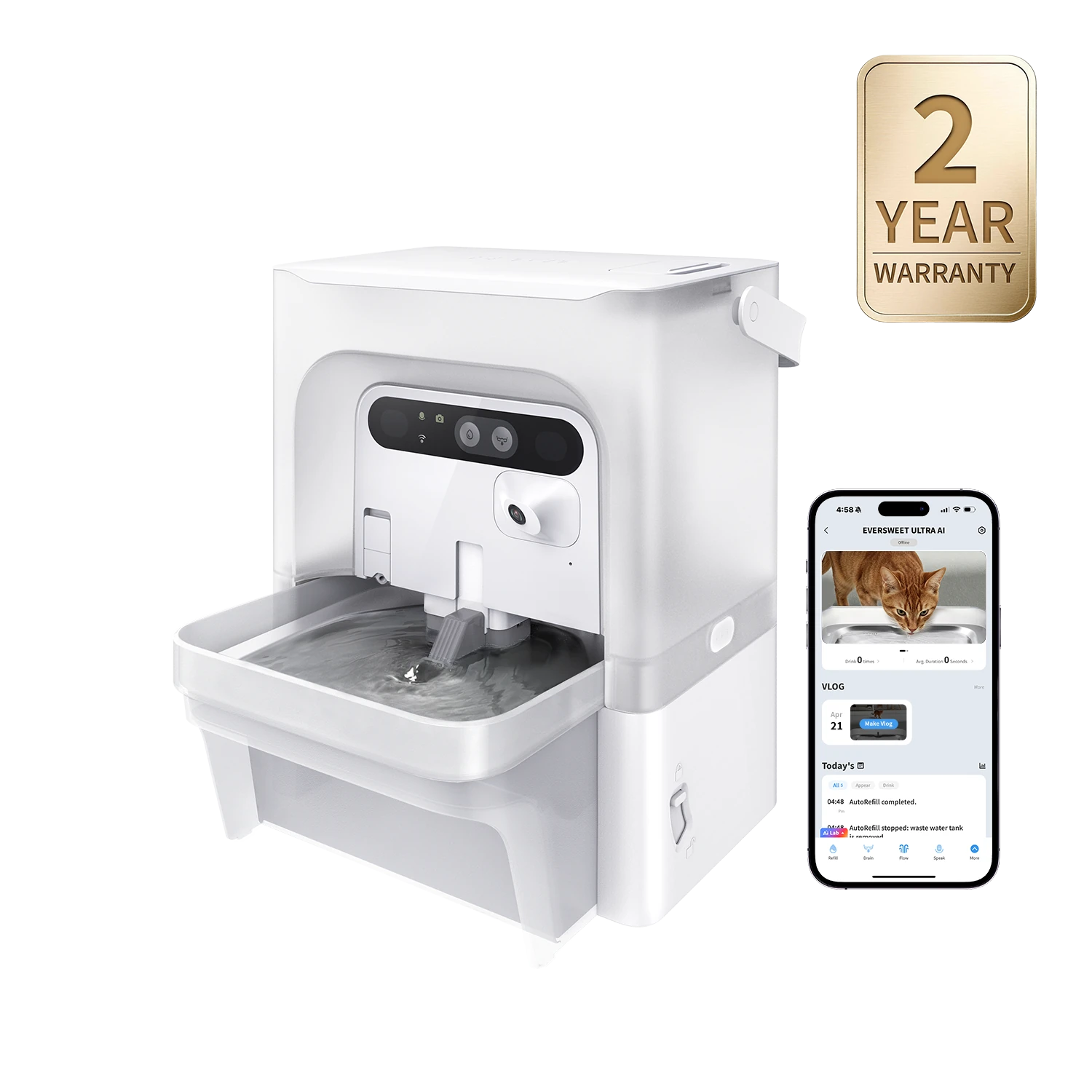
Explore this need in the finder →The PETKIT EverSweet Ultra P4117 is a substantial change from a small recirculating fountain. It has a five-liter clean-water tank, a separate 1.8-liter waste tank and a camera that supports pet profiles. It suits a household that wants this water-handling arrangement and is comfortable setting up an app and camera. The extra tanks, flushing controls and consumable Cube also create ownership tasks that deserve as much attention as the advertised capacity.
Understand where the water goes
The clean tank supplies the drinking tray, while a controlled drain sends tray water into the waste tank. The clean and waste capacities serve different purposes: adding them together would not produce a 6.8-liter drinking reservoir. PETKIT also explains that SpringFlow circulates water within the tray. The meaningful distinction is that drained used water goes into the separate waste tank rather than returning to the clean supply.
That arrangement requires checking both tanks. Flushing consumes clean water and fills the smaller waste tank, so choosing more frequent flushing changes the refill and emptying workload. A large clean-water capacity does not establish a fixed number of unattended days. Household use, evaporation, cleaning settings and the number of pets all affect the actual routine.
Plug-in operation and first-use activation
The P4117 uses its supplied 12-volt adapter. It is not a battery fountain. The manual requires app pairing before the first water dispensing, so reliable initial setup belongs in the purchase decision even if the touch-panel refill and drain buttons will handle many later interactions.
The documented flow choices include continuous, intermittent and approach-activated flow. The manual describes the latter responding near the fountain, at approximately ten centimeters. Put the unit on a level indoor surface and check whether the cat's approach leaves a sensible detection path. The listed body height is about 13.89 inches; removing tanks and reaching the controls need additional clearance above and around that footprint.
Camera identification is a different system from collar tags
The current US page says its camera supports profiles for up to fifteen pets. Users add pet photos in the app, and the system associates visits with those profiles. That is a stated supported profile count, not a guarantee that every visit will always be classified correctly. A household needing collar-tag identification should compare the PETLIBRO PLWF305 instead.
The Ultra also provides direct dual-band Wi-Fi. It does not depend on another PETKIT feeder or litter box merely to create the fountain's network connection. Review the camera permissions and monitoring schedule before choosing its location. Turning detection off changes the event history available; do not expect the same records while explicitly disabling the feature that creates them.
The manual distinguishes basic event images from full recorded-video playback and highlights that require PETKIT Care+. Check the current service terms for the features you intend to use, including which records remain available under the chosen plan.
Cleaning is a set of specific component permissions
PETKIT identifies three dishwasher-safe parts: the water tray, fountain outlet and magnetic strainer. That permission does not extend to the electrical base. The manual places the pump and lift mechanism at the base and says not to rinse or immerse it. Keep small dishwasher parts contained so they do not disappear during a wash.
The first setup also includes cleaning the clean-water tank, waste tank and tray. Continue inspecting their surfaces rather than relying on an automatic flush as the only cleaning step. The manual's special boiling-water cleaning procedure has its own sequence and cooling precautions; it should not be improvised by pouring hot water through the assembled fountain during ordinary use.
Allow for the required Cube and waste-tank routine
The supplied Fountain Cube must remain installed, and the current page recommends replacing Cube C every thirty days. A design without the usual recirculating filter still has this specified replacement component. Include that recurring purchase in the ownership decision without assuming a current price or substituting an unverified third-party part.
Compare the EverSweet Max 2 UVC when genuine battery operation and a simpler three-liter reservoir matter more than the camera and waste-tank arrangement. The Catit Easy Clean is another useful comparison for a household concentrating on the physical cleaning routine. Choose the Ultra when its separate tanks and camera setup solve a real need together, with someone still checking water, waste and cleanliness regularly.
Key details at a glance
| Reservoir and capacity limits | 5 L clean-water supply and a separate 1.8 L waste tank. Waste capacity is not additional drinking-water capacity. |
|---|---|
| Power arrangement | Plug-in operation on the supplied 12 V, 2 A adapter. The first dispense requires app pairing; no operating battery is documented. |
| Water flow and conditions | Continuous, intermittent and approach-activated flow are described in the exact P4117 manual. Flush/drain/refill settings change clean-water use and waste-tank workload. |
| Drinking surface and wet parts | 304 stainless steel drinking tray with plastic clean/waste tanks. Pump and electronics remain in the non-immersible base; wet impeller and other water-contact parts still need care. |
| Cleaning and source limitations | The current US page permits dishwasher cleaning of the tray, fountain outlet and magnetic strainer only. Keep the electrical base out of water. Cube C must remain fitted; the recommended replacement interval is 30 days. |
| App and observation limits | The current US page supports camera profiles for up to 15 pets, with pet photos added in the app. Camera identification differs from RFID tags. The manual reserves full video playback/highlights for PETKIT Care+; confirm current service terms. |
| Confirmed body height | 13.89 in |
Use the exact model’s instructions for operating limits, supplied equipment and version differences.
Sources for this assessment
Find the configuration your household needs.
Start with power and water flow, then add surface, cleaning and observation requirements.