
On this page
Max 2 UVC keeps its wired and battery schedules distinct
P4116 supplies UVC hardware and a steel surface, but its documented rechargeable plan is a brief hourly interval rather than a transferable wired continuous mode. Its app connection is Bluetooth, with master-dependent remote interconnection rather than direct Wi-Fi. The cordless-UVC, app, interval and dishwasher answers explain those limits and the named cleaning parts.
Your needs, this model
Does it fit your priorities?
Can I require battery operation, timed flow, a steel drinking tray and three liters of capacity?
Yes. The exact P4116 guide documents battery interval operation, and the current US model supplies a 3 L reservoir with a steel tray.
Explore this need in the finder →Can I require confirmed continuous circulation while operating on battery?
That combination is not established. The linked guide reserves continuous flow for wired operation and describes battery intervals.
Explore this need in the finder →Does the supplied package combine UVC treatment with dishwasher permission for the steel drinking tray?
Yes. The current UVC package includes that pump, and its tray is explicitly included among the named dishwasher-safe removable parts. The base/control module are excluded.
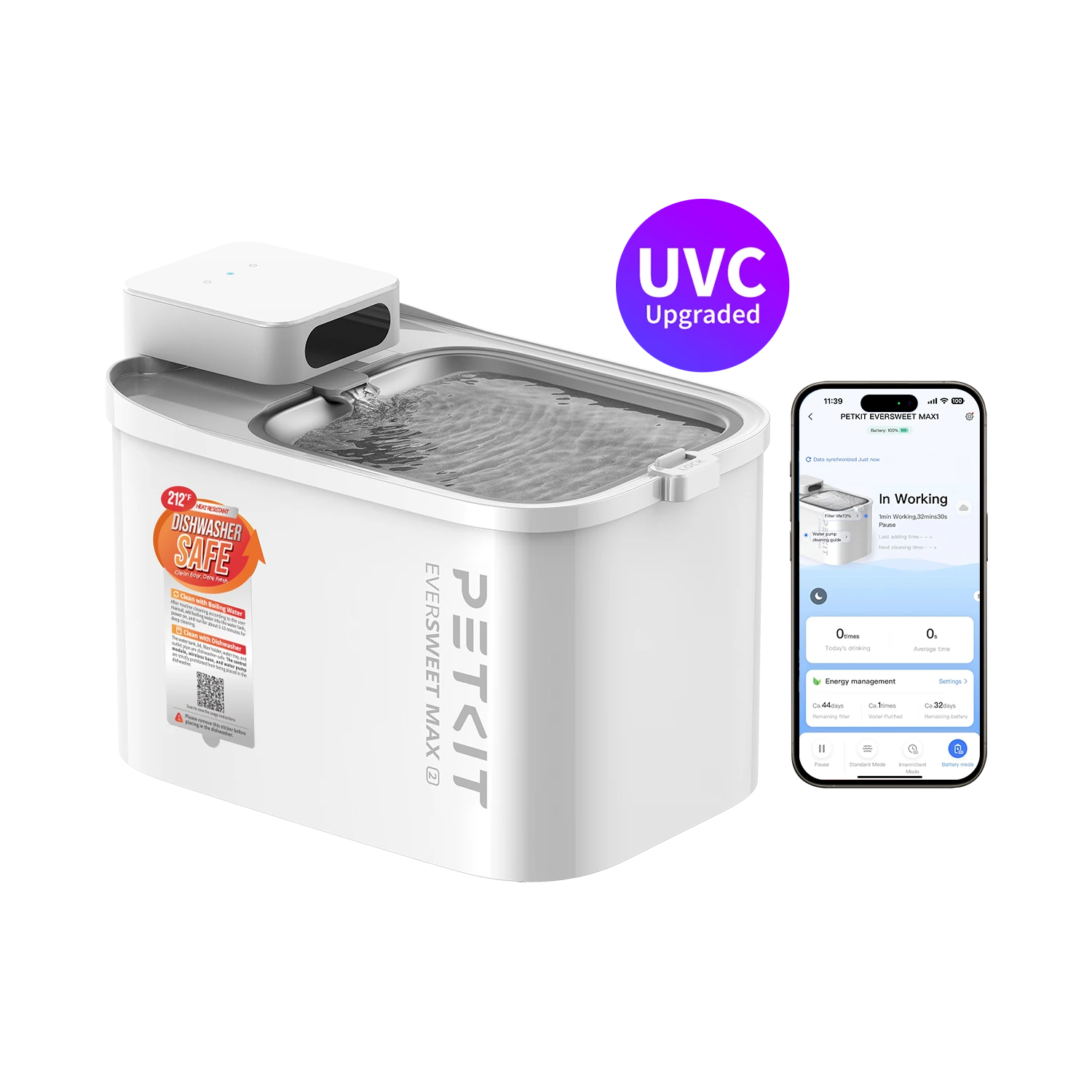
Explore this need in the finder →The PETKIT EverSweet Max 2 UVC P4116 combines a three-liter reservoir, a stainless-steel drinking tray, rechargeable operation and an included UVC wireless pump. Its most useful distinction from the earlier Max is the current model's documented heat-resistant removable parts and dishwasher permissions. It suits an owner willing to separate the wet pieces from the electrical control module and check the flow behavior of the supplied firmware.
Battery power is real, but mode conditions matter
The unit can operate on its built-in battery or USB power. The US page says the power adapter is not included and specifies five volts at one amp, so plan the appropriate power supply as part of setup. The battery powers the fountain itself, rather than merely preserving settings during a power interruption.
The manufacturer-linked P4116 manual describes continuous and intermittent choices while plugged in. Its battery section describes a default twenty-five-second dispense each hour, with frequency adjusted through app energy management. That is a different operating arrangement from continuously pumping on battery. The up-to-eighty-three-day promotion is not evidence of eighty-three days of continuous flow, and it says nothing about how long the water can be left unchecked.
The current US product page additionally advertises motion-activated flow, whereas the linked manual does not explain the corresponding power and firmware conditions. The confirmed baseline is wired continuous or intermittent operation and battery interval operation; obtain the exact current instructions before relying on a particular battery-and-sensor combination.
Steel tray, plastic reservoir, separate electronics
The drinking tray is 304 stainless steel. The reservoir and other parts are different materials, so this is not an all-steel water path. The current US specifications clearly label the body dimensions as width, depth and height, with the height given as 7.51 inches. Leave additional room to lift the tank and control module and to handle the lid.
The wireless pump eliminates an exposed cable between that pump and its powered base, but remains an electrical pump in the wet assembly. A lift-off tank containing such a pump is different from a reservoir whose motor and electronics all stay in a dry base. Compare those constructions specifically if that separation is the main reason for replacing an existing fountain.
Dishwasher permission has a component boundary
The current comparison lists the tank, tray, lid, filter holder and outlet pipe as dishwasher-safe parts. Remove the control module and wireless base and keep them out of the wash. The manual expressly prohibits rinsing or soaking those electrical components. The broad advertising phrase about dishwasher-safe construction should not override the more specific removable-parts list.
The linked cleaning guidance recommends at least weekly tank cleaning and a deeper monthly clean, adjusted for the household's water and use. Filters have their own replacement schedule, with the current FAQ suggesting four weeks. Replacing a filter does not clean the tray, water passage or pump, and neither interval is a reason to ignore visible debris earlier.
App records are visits, not a measured intake total
The fountain connects to the PETKIT app by Bluetooth. The documented records cover drinking frequency and duration, alongside battery, filter and water-status information. Those are useful activity records, but they do not establish an individually measured milliliter total for each cat. Multiple profiles do not turn this sensor system into RFID or camera identification.
Direct phone interaction needs Bluetooth proximity. The manual describes remote interconnection through a compatible PETKIT master, not direct Wi-Fi in the fountain. Its interconnection section names PETKIT smart-feeder and self-cleaning litter-box series as supported; it excludes Fresh Element P512 and Fresh Element Mini P530, and requires pairing within 8 meters with current master software. Two current U.S. bundle pages pair this P4116 with YumShare Solo 2 P572 or YumShare Dual-Hopper 2 P592. The guide names the feeder family rather than those codes individually, so treat those exact bundle pairings as a series-level master setup, not a model-code certification. Without a compatible master, plan on local Bluetooth.
Where it belongs on a shortlist
The included UVC pump requires care alongside the filter, tray and water passages. Continue routine cleaning and water changes. Low-water automatic shutdown is documented, but an owner should still check the actual water and operation.
The original EverSweet Max is a relevant alternative if hand washing and its coated tray are acceptable. The PETLIBRO PLWF116 is worth comparing when direct Wi-Fi intake records are the priority. Choose the Max 2 UVC for the specific combination of battery placement, its supplied pump and the named washable parts, while resolving any essential sensor-mode requirement for the exact delivered version.
Key details at a glance
| Reservoir and capacity limits | 3 L reservoir. Capacity and the advertised maximum battery duration do not establish days without inspection or refilling. |
|---|---|
| Power arrangement | Built-in battery or 5 V, 1 A USB input; the current US package excludes the adapter. Continuous flow is documented while plugged in; battery baseline is timed dispensing. |
| Water flow and conditions | The linked P4116 guide supports wired continuous/intermittent flow and battery intervals, initially 25 seconds per hour. Current US motion-sensor advertising lacks the same power/firmware detail; that combination remains unconfirmed for hard matching. |
| Drinking surface and wet parts | 304 stainless steel drinking tray over a plastic reservoir. The wireless electrical pump remains in the wet assembly; it is not a reservoir containing only wet mechanical parts. |
| Cleaning and source limitations | Current US comparison permits dishwasher cleaning of tank, tray, lid, filter holder and outlet pipe. Exclude the electrical control module/base and follow the pump's own care instructions. Guide suggests weekly tank and monthly deep cleaning; FAQ suggests four-week filter replacement. |
| App and observation limits | P4116 itself connects to the PETKIT app by Bluetooth, not direct Wi-Fi. Its exact guide, Interconnection section (printed p.16), says remote operation needs a separate master device; it lists PETKIT self-cleaning cat-litter-box and smart-feeder series as supported, names Fresh Element P512 and Fresh Element Mini P530 as unsupported, and requires setup within 8 m with current master software. The official U.S. collection has two Max 2 (UVC) bundles: YumShare Solo 2 P572 + P4116 and YumShare Dual-Hopper 2 P592 + P4116. The bundle pages identify exact included feeders; because the guide names the supported feeder series rather than those codes individually, this is a disclosed series-level mapping, not individual-code certification. Without a compatible master, treat the fountain as local Bluetooth. |
More specifications and setup details
| Confirmed body height | 7.51 in |
|---|
Use the exact model’s instructions for operating limits, supplied equipment and version differences.
Sources for this assessment
- EverSweet Max 2 UVC P4116 current US official product page
- EverSweet Max 2 UVC P4116 manufacturer-linked operating guide
- PETKIT U.S. manual index with separate Max 2 and Max 2 (UVC) entries
- YumShare Solo 2 + EverSweet Max 2 (UVC) official U.S. bundle; exact parts/model codes
- YumShare Dual-Hopper 2 + EverSweet Max 2 (UVC) official U.S. bundle; exact parts/model codes
Find the configuration your household needs.
Start with power and water flow, then add surface, cleaning and observation requirements.
Your needs, this model
Rechargeable cat fountains with app drinking-activity records
Choose it when: The exact P4116 package documents app activity records, supplied UVC hardware and a separate rechargeable interval plan.
Rechargeable cat fountains with app drinking-activity records →Rechargeable cat fountains with app control
Choose it when: The exact P4116 page documents app control, while its model-specific guide documents the rechargeable interval plan and identifies Bluetooth rather than direct Wi-Fi.
Rechargeable cat fountains with app control →Rechargeable cat fountains with dishwasher-safe drinking surfaces
Choose it when: The exact P4116 guide names its battery interval schedule and stainless-steel drinking tray; exact cleaning sources permit specified non-electrical surface parts only.
Rechargeable cat fountains with dishwasher-safe drinking surfaces →