
Your needs, this model
Does it fit your priorities?
Can this fountain offer both a raised drinking bowl and a lower open bowl while running continuously from an outlet?
Yes. The current PWW00-13708 has an upper and lower bowl with one free-falling stream and one documented continuous, plugged-in operating plan. Both levels belong to the same circulating fountain, not separate pumps.
Explore this need in the finder →Can I get at least 2.9 liters nominal, a plastic drinking surface, and top-rack permission for its non-electrical fountain parts?
Yes. The 100 US fl oz label converts to about 2.96 L; the surfaces are BPA-free plastic, and current instructions allow top-rack washing of the plastic fountain parts after removing the pump, adapter and filter.
Explore this need in the finder →Does the 100 oz Multi-Tier meet a strict 3-liter nominal capacity requirement?
No. One hundred US fluid ounces is about 2.957 L, just below 3.0 L; do not round the stated ounce capacity upward to satisfy a hard threshold.
Explore this need in the finder →Can I require a stainless-steel drinking surface on this Multi-Tier?
No. PetSafe identifies the supplied fountain parts and bowls as BPA-free plastic, not stainless steel.
Explore this need in the finder →Can the fountain circulate from a rechargeable battery without a nearby outlet?
A battery operating setup is not documented. The exact guide says the fountain is intended to run continuously while plugged in; water left in the bowls when power stops is not battery-powered circulation.
Explore this need in the finder →Can I require automatic low-water shutoff for the submersible pump?
That protection is not confirmed. PetSafe warns owners to keep the water at least one inch from the base of the bowl to avoid possible pump failure; a low-water warning is not evidence of an automatic cutoff.
Explore this need in the finder →The PetSafe Drinkwell Multi-Tier Pet Fountain PWW00-13708 is a plug-in, 100-ounce station built around two places to drink: a raised upper dish and a wide lower bowl, joined by one falling stream. The exact current U.S. store page identifies the product and its 100 oz capacity; PetSafe's product-support page also lists PWW00-13708 and the support code DMLR-PLAS. This review evaluates the named PWW00-13708 configuration, not every older Drinkwell model or a support code assumed to be a separate purchasable fountain.
Two heights, one water circuit
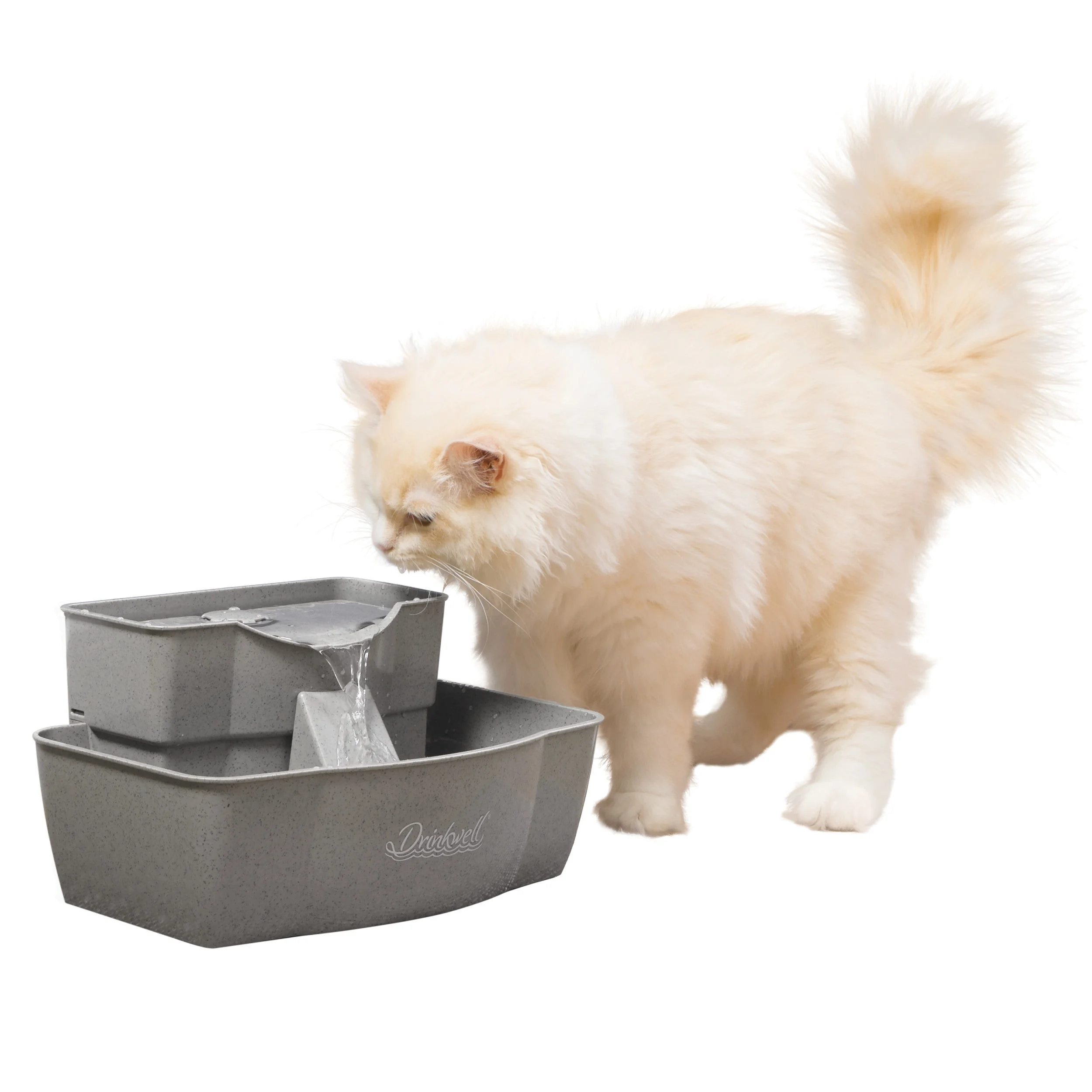
The practical distinction is the stacked layout. A cat can drink from the upper bowl, the lower bowl, or approach the falling water between them. That gives a household more than one comfortable height to try without buying a fountain with separate pumps or individually controlled basins. PetSafe specifically points to the elevated dish as a useful option for older pets; whether its height suits a particular cat still depends on the animal and where the fountain will sit. The manufacturer gives only the two-value product dimension entry “8.0 x 5.6 inches,” without labeled axes or a third dimension, so it is not enough to confirm counter clearance or body height. Measure the intended space rather than estimating from the product image.
The Multi-Tier's one free-falling stream is not adjustable. Its water presentation is simpler than the Drinkwell Pagoda, whose exact review describes two falling streams and a ceramic raised dish, and it does not offer the Platinum's physical flow adjustment. If a cat prefers drinking from a bowl rather than directly at falling water, the upper and lower bowls remain distinct places to approach, but they are connected parts of a single circulating fountain—not separate measured reservoirs. A flow-sensitive cat may need a gradual introduction to a continuous stream rather than an assumption that this pump can be turned down.
Capacity is near three liters, not over it
PetSafe labels this configuration at 100 U.S. fluid ounces, which converts to about 2.96 liters. It is a nominal capacity, not a measured usable fill or a promise about days between checks. That number is large enough to be a meaningful step above compact bowls, but the Multi-Tier does not reach a strict 3-liter minimum. If that threshold is essential, the current product pages describe the larger Drinkwell Platinum at 168 oz and Oasys at 256 oz; neither should be substituted automatically, since their layouts and cleaning work differ. The Platinum review covers its rear refill reservoir and adjustable stream, while the Pagoda assessment covers its ceramic twin-stream layout.
The product page says the open-bowl design leaves pets access to water if power stops. That is passive water already in the bowls, not continued circulation. The exact PWW00-13708 quick-start guide says the fountain is intended to run continuously while plugged into a standard outlet, as long as water is maintained and the fountain is cleaned. It specifies 2.5 watts. There is no documented rechargeable plan, interval setting, pet sensor, app, intake record, or automatic low-water cutoff. The guide instead warns that the pump may fail if water falls below one inch from the bowl base. Owners should treat regular visual checks as part of the setup rather than count a warning as protection.
Plastic and a manageable—but real—pump routine
The supplied wet surfaces are BPA-free plastic. The official support image shows the gray, speckled two-tier fountain with a cat beside it; the maker does not identify whether the product image is photography or a rendering, so it is not a reliable size reference. PetSafe's guide also cautions that some animals can be sensitive to plastic food or water containers. A strict stainless-steel or ceramic requirement rules this model out regardless of the color or appearance in a listing.
Cleaning claims need a component boundary. Current PetSafe cleaning instructions say to wash the plastic fountain pieces in warm soapy water or place them on the dishwasher's top rack; the pump, adapter and filters stay out. The pump needs separate disassembly and cleaning. The online Multi-Tier instructions call for a full fountain clean at least monthly, more often in multi-pet homes, with pump and filter care coordinated with that task. Current filter instructions set a two-to-four-week replacement interval and say to rinse media with water only—not soap or in a dishwasher. This is separate from the full cleaning schedule. Hard-water guidance is version-sensitive: the older exact guide gives an 80/20 water-and-vinegar mix, while current pump-care instructions give 50/50. Follow current model-specific directions, rinse thoroughly, and do not combine recipes.
Who should choose another layout?
This is worth considering when a household wants one continuous outlet-powered fountain, a nominal 100 oz capacity, and two connected drinking heights in plastic, and can make routine water checks and pump cleaning. It is a poor fit when three liters is a hard minimum, steel or ceramic contact is required, the fountain must circulate away from an outlet, or hands-off low-water protection is essential. Compare the Pagoda for ceramic and twin streams, the Platinum for a higher labeled capacity and adjustable flow, or a gravity-fed station if the actual need is water access without power. Those alternatives solve different problems; a larger label, raised dish, or bowl that retains water does not by itself make one design a substitute for another.
Key details at a glance
| Reservoir and capacity limits | 100 US fluid ounces nominal fountain capacity, approximately 2.957352956 L by unit conversion. The named volume is not measured usable water or a refill-duration promise; PetSafe does not say how long this will last for a particular household. |
|---|---|
| Power arrangement | The PWW00-13708 quick-start guide says to operate continuously while plugged into a standard wall outlet as long as water is maintained and the fountain is cleaned; it lists 2.5 W. The submersible pump sits in the bowl. Bowl water may remain available if power stops, but no rechargeable circulation plan is documented. |
| Water flow and conditions | One free-falling stream feeds the connected upper and lower bowl arrangement. The current product page says water flow is non-adjustable; no sensor, timed or app-controlled plan is established. |
| Drinking surface and wet parts | PetSafe identifies BPA-free plastic fountain parts. The model has an upper dish and lower open bowl; the submersible pump is in the bowl and the adapter/filters are separate. The guide cautions that some animals may be sensitive to plastic water containers. |
| Cleaning and source limitations | Current PetSafe Multi-Tier support says to clean the fountain at least monthly and more often in multi-pet homes, clean the pump during full cleaning, wash plastic fountain pieces with warm soapy water or use the dishwasher top rack, and keep pump, adapter and filters out of the dishwasher. Replace carbon filters every 2–4 weeks; rinse media with water only. Hard-water guidance differs between the older exact guide (80/20 water/vinegar) and current support (50/50); follow current model-specific directions rather than blending them. |
| App and observation limits | The current exact page, product-support page and model guide describe physical bowls, a falling stream and continuous outlet power; they do not document app control, Wi-Fi, individual-cat intake records, a nightlight, supplied UVC or automatic low-water shutdown. Unknown features remain unconfirmed, not presumed absent by independent test. |
Use the exact model’s instructions for operating limits, supplied equipment and version differences.
Sources for this assessment
- Current U.S. PetSafe Drinkwell Multi-Tier product page, PWW00-13708
- PetSafe Multi-Tier product-support page
- PetSafe Drinkwell Multi-Tier Quick Start Guide RE400-1365, 8 pages
- Current PetSafe Multi-Tier disassembly and cleaning instructions
- Current PetSafe Multi-Tier carbon filter replacement instructions
- Official exact-model Multi-Tier image served on PetSafe product and support pages
- Current PetSafe Multi-Tier pump troubleshooting and hard-water care instructions

Find the configuration your household needs.
Start with power and water flow, then add surface, cleaning and observation requirements.