
Your needs, this model
Does it fit your priorities?
Is an outlet-powered fountain with continuous two-stream flow acceptable?
Yes. The Pagoda uses a low-voltage submersible pump with an adapter and is intended for continuous plugged-in operation; it is not documented as rechargeable.
Explore this need in the finder →Do you want a ceramic drinking surface rather than stainless steel?
The Pagoda bowl and tower are ceramic, with non-ceramic pump, filter and seal parts.
Explore this need in the finder →Do you need at least 2.0 liters of nominal capacity?
Yes. The manufacturer names 70 US fluid ounces, approximately 2.07 liters by unit conversion.
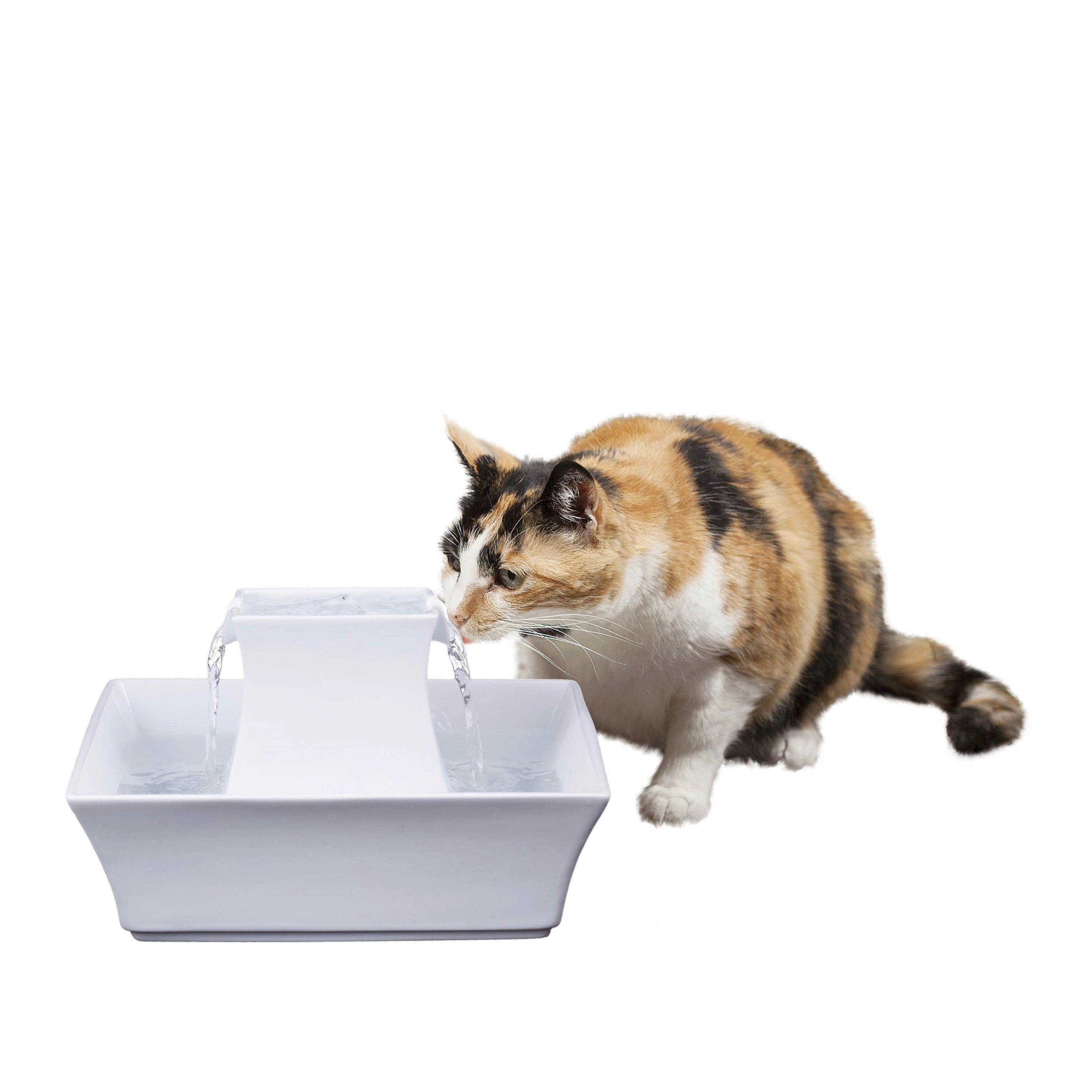
Explore this need in the finder →The PetSafe Drinkwell Pagoda is a 70-ounce ceramic fountain for a household that wants two falling streams and a higher drinking dish above an open lower bowl. Current U.S. variant data identifies White PWW00-13907 and Himalayan Blue PWW00-14898 as the available finishes. The same exact product record identifies Red PWW00-14289 and Taupe PWW00-14440 as Pagoda color variants, but marks both Unsupported and unavailable for sale in the current listing. They share the same 70-ounce function and family guide rather than adding a different flow or capacity configuration. The official record contains a Taupe image but no Red-variant media; the White image shown here does not establish either color.
Two levels, one continuously powered fountain
A small submersible pump lifts water through the tower and filter housing, then the top sends it down in two free-falling streams. The 70-ounce rating describes the whole fountain, not two independent reservoirs. A raised upper dish and the open lower bowl offer two places to drink at different levels. That makes the Pagoda worth considering if your cat approaches a stream but also uses a still pool, or if you want a higher dish as an alternative to bending toward the floor. PetSafe markets the height for senior pets; that does not establish a medical benefit or guarantee that this particular elevation suits an individual animal.
The current product page calls the flow non-adjustable. The manual describes a low-voltage 12-volt system, but the included adapter still needs an ordinary outlet and the guide says the fountain is intended to run continuously. This is not a cordless or rechargeable fountain, and it has no documented approach-sensor mode. If electricity is interrupted, the open lower bowl remains accessible while the pump is off; that retained water is useful as a passive drinking surface, not proof of a low-water pump cutoff. The manual warns not to let the level fall below one inch because the pump could be damaged. Check and refill it rather than relying on an automatic safety stop, which is not established for this model.
Capacity is useful only with a refill routine
Seventy U.S. fluid ounces converts to about 2.07 liters. Treat that as the named nominal capacity, not a measured amount of usable water or a promise of how long a household can leave it unattended. Evaporation, drinking, splashing and the need to keep water above the pump’s safe level all affect how often you must inspect it. A higher-capacity fountain can reduce refill frequency compared with a 60-ounce unit, but it does not eliminate the daily check.
The ceramic bowl and tower give the fountain a heavier, hard-surface feel than PetSafe’s plastic models. That can be attractive if you want the drinking surfaces to be ceramic, but the pump, filters, rubber seals and adapter are still separate parts. Ceramic also asks for care when taking the unit apart, moving it to the sink and returning it to the floor. No official body height or footprint measurement was confirmed in the sources read for this configuration, so reserve room for the assembled tower and a stable mat rather than estimating its size from a picture.
Dishwasher permission has a practical caveat
The current store page says the fountain is top-rack dishwasher safe. The exact Pagoda operating guide is more cautious: it says the fountain may go in a dishwasher but strongly recommends hand-washing ceramic fountains, and expressly excludes the pump. I would treat the ceramic as dishwasher-permitted but follow the more careful hand-washing recommendation if avoiding impact or movement in the machine matters to you. In either case, unplug the unit before disassembly, keep the adapter dry, and clean the pump separately rather than treating “dishwasher safe” as permission for every component.
The guide sets a fairly regular care rhythm: clean the fountain weekly, clean the pump about every two weeks, replace the charcoal filter every two to four weeks, and replace the foam filter every four to eight weeks. Rinse the carbon filter before installation, and do not wash the filter media with soap. The current product page lists Drinkwell Carbon Filter #6 PAC00-13906 and Foam Filter #5 PAC00-13711 as compatible, with replacement pump PAC00-13206. These consumables and the pump are ongoing parts of ownership, not optional decoration.
When another design fits better
Choose the Pagoda if ceramic, two descending streams and a raised upper dish matter more than variable flow or a dry-base pump. The Drinkwell Seascape is another 70-ounce ceramic option, but its documented presentation is a softer bubbling stream rather than the Pagoda’s twin falls. If keeping electrical parts out of the wet reservoir is essential, compare the Outlast 60; its separate dry base changes the cleaning and power arrangement, though it has less nominal capacity and a different surface. None of these choices establishes app records, individual-cat attribution, Wi-Fi, a nightlight or supplied UVC treatment for the Pagoda.
In short, the Pagoda suits a home with a nearby outlet, a place for a ceramic tower, and an owner comfortable lifting and cleaning several pieces on a recurring schedule. It is a poor fit if you need battery operation, adjustable streams, a documented low-water shutdown, confirmed app features, or a very compact shape with verified dimensions. Start with the drinking levels your cat actually uses and the cleaning method you will follow; the white-versus-blue finish is the least important difference between the current variants. Before ordering replacement parts, check the official Pagoda support page and its model guide against the exact code on your fountain.
Key details at a glance
| Reservoir and capacity limits | Named 70 US fluid ounces, approximately 2.07 L by unit conversion; a nominal capacity, not measured usable volume or days between refills. The upper dish and lower bowl share one circulating fountain, not separate 35 oz reservoirs. |
|---|---|
| Power arrangement | The exact Pagoda guide describes a low-voltage 12 V system with an included adapter and an outlet-powered continuous operating routine. The submersible pump is inside the wet ceramic bowl; no rechargeable or battery plan is documented. |
| Water flow and conditions | Two non-adjustable free-falling streams descend from the tower into an elevated upper dish and open lower bowl. The lower bowl remains available if power is interrupted; no sensor, interval, or app-controlled flow is documented. |
| Drinking surface and wet parts | The bowl and tower are described as ceramic. The pump, filter housing, foam/carbon media, rubber cap/grommet and adapter are separate materials; the complete wet path is not ceramic. |
| Cleaning and source limitations | Current product/support page says top-rack dishwasher safe, while the Pagoda operating guide says dishwasher use is possible but strongly recommends hand-washing ceramic fountains; the pump is excluded. Guide schedules fountain cleaning weekly, pump cleaning every two weeks, charcoal filter replacement every 2–4 weeks and foam replacement every 4–8 weeks. Rinse filters without soap. |
| App and observation limits | No exact-model source read documents app controls, Wi-Fi, individual-pet intake attribution, a nightlight or supplied UVC treatment. Product-page low-water protection is not documented; the manual warns against running the pump dry. |
Use the exact model’s instructions for operating limits, supplied equipment and version differences.
Sources for this assessment

Find the configuration your household needs.
Start with power and water flow, then add surface, cleaning and observation requirements.