
Your needs, this model
Does it fit your priorities?
Will PLWF006 fit a need for at least 3 L, outlet power, continuous flow and a steel tank?
Yes. The current page and exact manual identify a 3 L PLWF006 with an outlet-powered pump, continuous circulation and a 304 stainless tank. The water outlet is PP.
Explore this need in the finder →Can I require a dishwasher-safe steel drinking tank while hand-cleaning the electrical pump and adapter?
Yes, narrowly. PETLIBRO labels the stainless tank dishwasher-safe. That permission does not establish dishwasher care for the pump, adapter, filter media or every wet component.
Explore this need in the finder →Can I require this fountain to run from a rechargeable battery and activate only when a cat approaches?
No. Its exact manual and product page establish an included AC adapter and continuous pump; a battery or sensor plan is not documented.
Explore this need in the finder →Can I require a documented automatic low-water shutdown?
No confirmed feature is established. The manual warns the pump can fail if run dry and gives MIN/MAX water marks; it does not document an automatic cutoff.
Explore this need in the finder →Can I use this as a no-plug gravity bowl with no powered circulation?
No. PLWF006 needs the supplied adapter for the pump. For a passive bowl, compare a gravity water station instead.
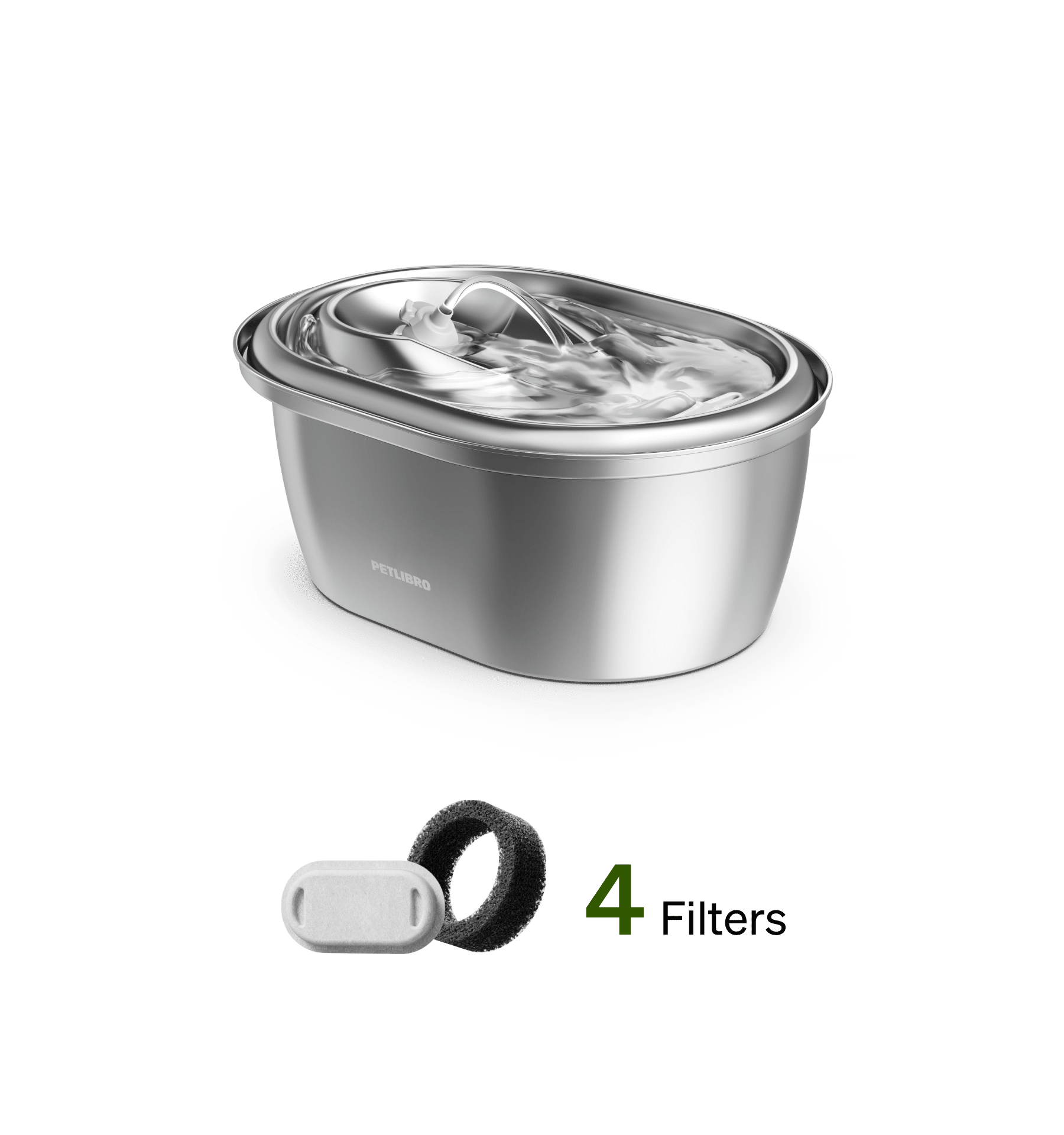
Explore this need in the finder →The current U.S. PETLIBRO listing for its Stainless Steel Fountain identifies the fountain as model PLWF006 and specifies a 3 L tank. The exact manual uses the same model number. The live variant selector shows the fountain with different replacement-filter bundles; its default “Fountain & 4 Filters” SKU is PL-WF006-03M. Those filter-count choices do not change the 3 L fountain itself. This assessment covers the current 3 L configuration, not an older listing that may describe a 2 L version under a similar family name. Check the model and stated capacity on a seller’s package before treating them as interchangeable.
A 3 L tank with a steel body, not an all-metal water path
PETLIBRO specifies a 3 L capacity and a SUS 304 stainless-steel tank. The listed dimensions are 10.8 by 8.1 by 4.7 inches, and the manual lists net weight as 717 g (1.6 lb). The document does not label each dimension by axis, so use the full printed size to check a shelf or counter rather than assuming which number is height. Capacity is a useful comparison point, not a promise about how long a household can leave the fountain unchecked. Drinking, spills, evaporation and a dirty filter all affect the routine.
The maker describes the water outlet as polypropylene (PP), even though the main tank is steel. This is a sensible option if a metal tank is important, but it is not a claim that every water-contact part is stainless. The product page advertises the stainless tank as dishwasher-safe. Read that narrowly: the manual places the pump, sponge, filter cartridge and holder inside the water tank, and the included adapter and cord are electrical parts. Take the fountain apart first and keep the pump, adapter, filter media and other components out of the dishwasher unless PETLIBRO confirms otherwise for the exact supplied part.
One plugged-in plan, with a physical flow adjustment
The supplied AC adapter accepts 100–240 V, 50/60 Hz and outputs 5 V at 1 A. The pump sits in the tank and the manual’s assembly sequence runs the power lead from the unit to the adapter. PETLIBRO says the water runs continuously; switching it off means unplugging it. A control at the water outlet changes the stream between a stronger and a slower presentation. That makes it possible to choose how water emerges without adding a timed schedule or pet-approach sensor. The supported plan remains outlet-powered continuous circulation.
At setup, soak the filter in a separate clean bowl for five minutes and rinse it before installing it. The guide warns not to soak the filter inside the fountain tank. Add water between the marked minimum and maximum levels, secure the cover, and only then connect power. The manual warns that the pump can fail if it runs dry. It does not document an automatic low-water cutoff, so do not rely on the fountain protecting itself when the level drops.
Cleaning is part of the operating cost
PETLIBRO’s manual calls for cleaning the pump and fountain at least every two weeks, replacing the carbon filter and sponge at least every two weeks, and more frequent filter changes for a household with multiple cats if the flow slows. Pump care means removing its cover and rotor and cleaning the parts with the supplied brush. The product page promotes three-layer filtration, but the manual’s day-to-day instructions emphasize the carbon filter and sponge; replacement frequency is a regular task, not something the 3 L tank removes.
The current product page has 4-, 8- and 12-filter bundle choices. That can make initial setup convenient, but compare the precise package contents when buying. PETLIBRO says to contact its support team for replacement filters; this review does not assume a filter’s price, future availability or compatibility with other PETLIBRO fountains. The manual also says the pump should never operate without water, and the fountain is intended for indoor use. Keep the adapter and connection dry and place the cord where it cannot become a trip or chewing hazard.
Who should consider PLWF006?
This model is worth considering when you want a continuously circulating fountain, a 3 L stainless-steel tank, a physical flow adjustment and a household routine that includes pump disassembly and frequent filter care. Its single outlet-powered plan is easy to understand, but it is not the right match if being able to move the running fountain away from a socket is essential. App controls, drinking records, individual-cat identification, UVC treatment, a supplied splash shield and automatic low-water shutdown are not established for this model. A matcher choice that requires one of those features should not treat PLWF006 as a substitute.
For a battery-powered option with app features and more than one documented flow mode, compare the PETLIBRO Dockstream 2 Cordless PLWF116; it adds charging and setup considerations and should not be conflated with this simpler plug-in fountain. If you want no cord and do not need moving water, the PetSafe Healthy Pet Water Station Small uses gravity to replenish a stainless bowl instead. PETLIBRO’s current PLWF006 product page and its PLWF006 manual are the key references for package details, assembly, water level and care. Match the exact 3 L model and the filter bundle you intend to purchase.
Key details at a glance
| Reservoir and capacity limits | The exact current U.S. page and PLWF006 manual specify 3 L. This is reservoir capacity, not usable water between checks or a refill-time promise. |
|---|---|
| Power arrangement | One outlet-powered plan uses the included 100–240 V, 50/60 Hz input / 5 V, 1 A output adapter. The AC pump is inside the water tank; no battery plan is documented. |
| Water flow and conditions | The exact product page says the pump runs continuously until unplugged. A water-flow controller on the outlet gives stronger and slower stream presentations; no sensor or timed mode is documented. |
| Drinking surface and wet parts | The product page identifies a 304 stainless-steel tank and a polypropylene water outlet. Do not describe the entire water path as steel. |
| Cleaning and source limitations | The current page calls the stainless tank dishwasher-safe. The manual requires filter soaking/rinsing, pump/fountain cleaning and carbon-filter/sponge replacement at least every two weeks. Remove pump/adapter and do not extend tank-only dishwasher permission to undocumented components. |
| App and observation limits | The product page and exact manual do not document app control, pet-level drinking records, Wi-Fi, UVC or a nightlight. These features remain unconfirmed rather than inferred from another PETLIBRO model. |
Use the exact model’s instructions for operating limits, supplied equipment and version differences.
Sources for this assessment
Find the configuration your household needs.
Start with power and water flow, then add surface, cleaning and observation requirements.