
On this page
Your needs, this model
Does it fit your priorities?
Can Botanical #3057 meet a plastic, continuously filtered, wired fountain need with a 1.4 L minimum?
Yes. The exact listing supports plastic, continuous filtration and USB-or-plug power, with listed 50 fl oz (1.48 L) nominal capacity. This is not a refill interval.
Explore this need in the finder →Does the maker’s 50 oz figure satisfy a strict 1.5 L minimum?
No. The exact #3057 page lists about 1.48 L, below the hard threshold.
Explore this need in the finder →Can #3057 run on an internal battery with no external power?
A battery configuration is not documented; the page specifies USB or plug power cord.
Explore this need in the finder →Can its dishwasher-safe requirement be treated as documented?
The exact page says dishwasher safe. Use the model instructions to identify washable pieces; electrical components should not be dishwashed.
Explore this need in the finder →Is #3057 proven to fit under a strict nine-inch-high cabinet?
No confirmed height is supplied. The page prints 9.25 × 6.5 × 9.25 inches without labeling axes, so a strict fit cannot be accepted from that string.
Explore this need in the finder →Pioneer Pet’s Botanical Fountain #3057 is a limited-edition plastic fountain whose official product page lists 50 U.S. fluid ounces (1.48 L), continuous filtration, dishwasher-safe cleaning, a USB-or-plug power cord, and three replacement filters. The maker lists replacement filter #3003 and replacement pump #3077. The published details make its limits unusually important: the nominal volume is below 1.5 L, the power description is wired rather than cordless, and the page’s three-number dimensions do not label which axis is height. Treat the exact model code—not the edition name alone—as the first thing to verify in a retailer listing.
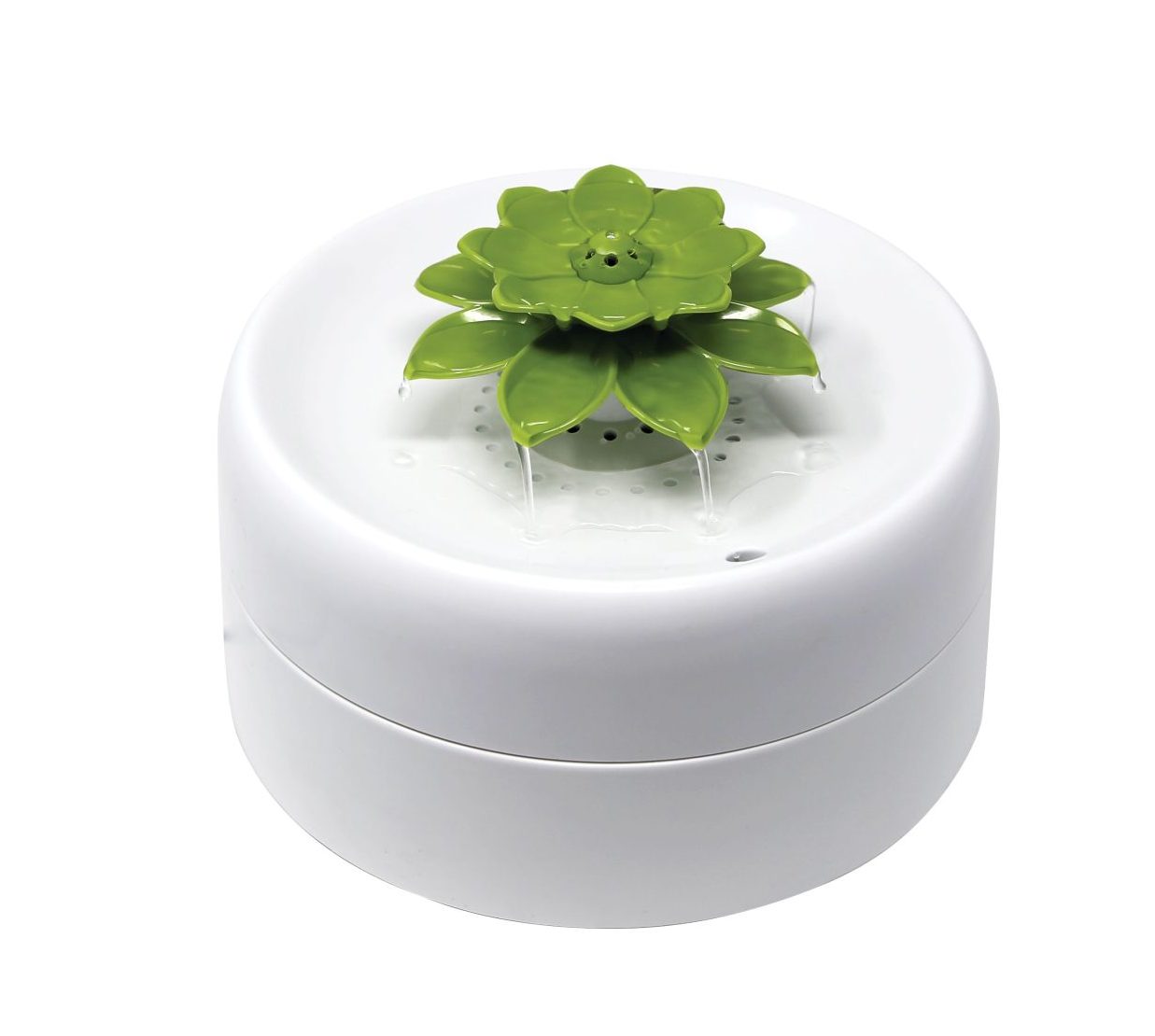
Image source and model notes
Botanical #3057 is not just a feature name
The exact manufacturer page names Product Code 3057 and calls it the Botanical Fountain-Limited Edition. That is enough to distinguish it from its separate Blossom #3056 listing, even though the two pages describe the same major functional specifications. Pioneer publishes the same 50 oz / 1.48 L capacity, 9.25 × 6.5 × 9.25 in dimensions, three included replacement filters, USB-or-plug wording, #3003 filter, and #3077 replacement pump for both. I would not claim that #3057 has a different flow rate, filtration result, refill interval, or durability; the published specifications do not establish any such advantage.
When comparing the two, make the aesthetic choice from the manufacturer’s exact #3057 image and verify that the pictured Botanical edition matches the retailer’s SKU. A product title or a generic flower-shaped fountain photo is not an identity check. If a seller cannot confirm 3057, ask for a photograph of the model label or choose an exact listing that clearly names the model. This avoids an easy mix-up with #3056 or another Pioneer Pet plastic fountain whose parts and capacities may differ.
Capacity and placement have firm limits
The 50 U.S. fluid ounces stated by Pioneer Pet is approximately 1.48 liters. That is suitable only if your requirement is at or below the maker’s nominal figure; it does not meet a strict 1.5-liter minimum. The difference is small, but a hard threshold should be interpreted as written. A reservoir’s advertised capacity also should not be treated as usable water above the pump or as an estimate of days between refills. The product listing gives no measured usable volume, consumption test, or refill schedule.
Pioneer publishes 9.25 × 6.5 × 9.25 inches, but labels no dimension as height or width. A 9-inch maximum-height filter should not accept this model based on guesswork; the maker’s page does not provide a confirmed vertical measurement. The fountain may still fit many counters, but a cabinet, shelf, crate opening, or tight feeding station warrants a direct measurement from the seller. The product page does not state empty weight either, so it cannot support a strict weight limit.
Power and maintenance questions to confirm
“USB or plug power cord” describes two corded ways to supply the unit, not a rechargeable battery. If the drinking station must run away from an outlet or continue circulating through a power cut, the listing does not document a battery plan or reserve. It does not specify app control, drinking records, a low-water alert, or automatic pump shutdown. Those omissions stay unknown; they are not positive feature claims. The manufacturer names #3077 as the replacement 5 V pump and transformer, while the exact retail-box adapter arrangement is not spelled out. Confirm what arrives with the particular #3057 package and follow its included instructions for hookup and fill level.
The page says “dishwasher safe for easy cleaning” and includes three replacement charcoal filters. It does not give a filter-change interval or specify every dishwasher-safe part. Use the supplied manufacturer instructions to identify the washable components; keep the pump, cord, plug, and transformer out of the dishwasher. Replacement #3003 filters and the #3077 pump are useful exact part terms, but their existence does not establish their current price or a retailer’s stock.
Purchase only when the seller can verify #3057
The direct Pioneer Pet listing currently says out of stock and directs fountain buyers to retailers. External availability, seller reputation, condition, current price, and completeness remain unverified. Search “Pioneer Pet Botanical Fountain #3057” and check that exact model code on the listing and box. Pioneer’s own pages for #3056 and #3057 present matching published operating specifications; if a retailer cannot show which version it carries, do not pay a design premium on the assumption that the interior hardware differs.
#3057 belongs on a shortlist when a plastic, continuously filtered, external-powered fountain with roughly 1.48 L nominal volume fits the routine and the Botanical edition is the exact style wanted. A larger-volume model is a better starting point for a strict capacity threshold; an outlet-free fountain is needed for battery operation; and a lower-height setup needs an axis-labeled measurement. The useful distinction is not a promised performance edge over Blossom, but the exact item you will receive and whether its limits match your actual requirements.
Manufacturer references: Pioneer Pet Botanical #3057 product page and its Product Instructions index, which links the Botanical-specific instructions.
Key details at a glance
| Reservoir and capacity limits | The exact #3057 Pioneer Pet product page states 50 U.S. fl oz (1.48 L). This is nominal listed capacity, not measured usable volume above the pump, outage reserve, or refill interval. |
|---|---|
| Power arrangement | The exact product page says ‘USB or plug power cord.’ Both listed options require an external wired supply; the page does not document battery operation. Exact cord/adapter contents in external retail packages are unverified. Replacement pump #3077 is listed as a 5 V pump and transformer. |
| Water flow and conditions | Pioneer’s exact product page describes continuous filtration. No sensor, interval, app-controlled or battery mode is specified. |
| Drinking surface and wet parts | The manufacturer categorizes exact model #3057 as plastic and calls it dishwasher safe. It does not itemize every washable component; do not put the pump, cord, plug or transformer in a dishwasher. |
| Cleaning and source limitations | The exact page lists three replacement filters and claims dishwasher-safe cleaning but gives no filter-change or cleaning cadence. Use the supplied #3057 instructions to identify removable/washable pieces and assembly/water-level requirements. Replacement filter #3003 and pump #3077 are named by the maker. |
| App and observation limits | The exact listing does not specify app control, intake records, pet identification, low-water alert/shutdown, or outage reserve. These remain unknown and cannot meet an essential questionnaire requirement. |
Use the exact model’s instructions for operating limits, supplied equipment and version differences.
Sources for this assessment
Find the configuration your household needs.
Start with power and water flow, then add surface, cleaning and observation requirements.